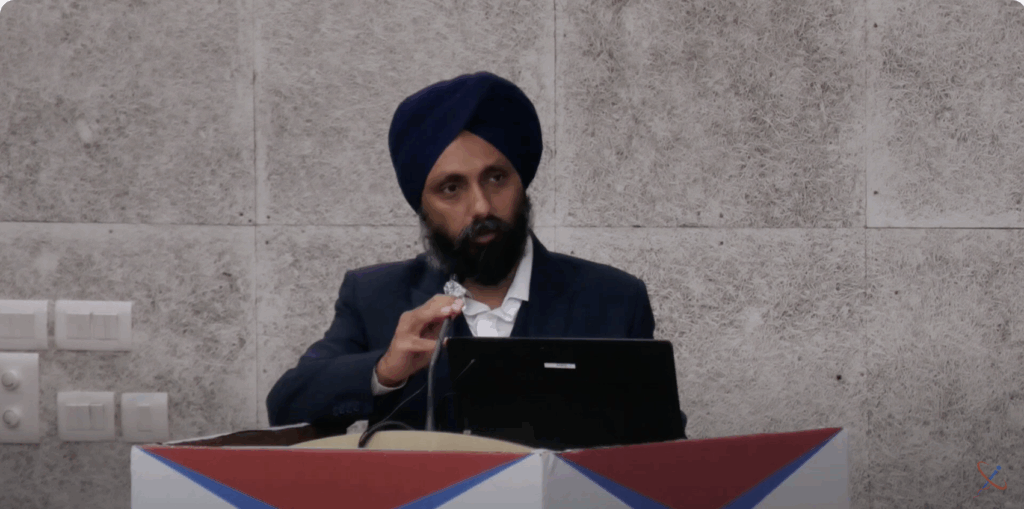
Session 1 – Inaugural – InnoHEALTH 2024 – 15 November
- October 13, 2025
- 12:41 pm
This year’s conference brought together healthcare professionals, innovators, and visionaries to discuss AI, digital health, climate change, and groundbreaking innovations in the healthcare sector. A significant highlight was the heartfelt tribute to the late Surgeon Rear Admiral Dr. V.K. Singh, a pioneer in healthcare innovation, whose legacy continues to shape the future of medical advancements.
This session celebrates the enduring legacy of Dr. Singh, whose visionary contributions have redefined emergency response and healthcare delivery worldwide. His groundbreaking work in developing efficient ambulance systems set new benchmarks for rapid and coordinated medical care. Beyond emergency services, Dr. Singh played a pivotal role in shaping global healthcare management strategies that prioritize accessibility and innovation. The speakers reflected on how his leadership and foresight continue to influence modern healthcare practices. Ultimately, his legacy serves as a guiding light, inspiring future generations to pursue excellence and innovation in healthcare.
Summary
InnoHealth 2024: A Tribute to Vision, Innovation, and the Future of Healthcare
Table of Contents
- Introduction
- Opening Ceremony: Setting the Vision
- Welcoming Address by Dr. Tappreet Sethi
- Remembering Dr. V.K. Singh: A Legacy of Innovation
- Tribute by Major General Jagtar Singh
- Personal Reflections by Dr. S.S. Mukherjee
- Guest of Honour Address by Padma Shri Dr. Arvind Lal
- Vote of Thanks by Mr. Sachin Kaur
- Conclusion
- Key Takeaways
Introduction
“In the words of Francis Collins, ‘The future of healthcare is not just about science and technology; it’s about using those tools to improve lives in meaningful ways.’
With this spirit, InnoHealth 2024 commenced—a celebration of innovation, empathy, and the enduring legacy of Dr. V.K. Singh.
Jointly hosted by InnoVrio Curis and the Indraprastha Institute of Information Technology (IIIT Delhi), this seventh edition of the conference brought together healthcare leaders, innovators, researchers, and policy makers under one roof to reimagine the intersection of healthcare, climate change, and digital transformation.
Opening Ceremony: Setting the Vision
The event began with hosts Ms. Tuba Khan and Ms. Maryam Khan welcoming participants from across the globe. They highlighted InnoHealth’s mission — to build a collaborative ecosystem for healthcare professionals, entrepreneurs, and thought leaders.
This year’s edition introduced four special recognitions:
- Climate Change Hackathon Winners
- Young Innovators Award
- Nursing Innovation Award
- E-Poster Winners
The ceremony underscored a central theme: healthcare innovation must not only transform systems but also touch lives.
Welcoming Address by Dr. Tappreet Sethi
Dr. Sethi, Associate Professor at IIIT Delhi, opened with heartfelt remarks, recalling the visionary influence of the late Dr. V.K. Singh, whose passion for digital health and AI shaped the conference’s identity.
She shared how InnoHealth evolved since its inception in 2019—driven by the idea that digital technologies and AI form the core of modern societal revolutions.
Dr. Sethi emphasized three central pillars guiding InnoHealth’s work:
- Interdisciplinary Innovation – integrating IT, biology, and mathematics.
- Collaborative Learning – bridging research with implementation.
- Sustainability – using digital tools to address global health and climate challenges.
She concluded with optimism for discussions on AI in radiology, climate-health intersections, and the power of collaboration.
Remembering Dr. V.K. Singh: A Legacy of Innovation
Following the welcome, the gathering paused to honor Rear Admiral (Dr.) V.K. Singh, a visionary who merged the disciplines of medicine, leadership, and innovation.
As former President of the Association of Healthcare Providers (India) and Chairman of the Quality Council of India’s Healthcare Division, Dr. Singh’s career exemplified excellence and purpose.
His colleagues described him as a leader who believed that healthcare innovation is not an option—it is a duty.
The tribute acknowledged his lifelong contributions to digital health, AI integration, and organizational excellence through InnoVrio Curis and the InnoHealth platform.
Tribute by Major General Jagtar Singh
Major General Jagtar Singh delivered a deeply moving eulogy, recounting personal memories of working with Dr. Singh in the Armed Forces Medical Services.
He described Dr. Singh as a towering figure of humility, discipline, and courage, whose leadership combined military precision with human compassion.
Highlights of Dr. Singh’s contributions included:
- Revolutionizing combat medical care by improving manpower and readiness in field hospitals.
- Establishing mobile blood supply systems for field surgical units, a system still in use today.
- Defining ambulance requirements and emergency frameworks — a foundational study still referenced in Indian healthcare planning.
Post-retirement, Dr. Singh continued to lead transformative initiatives:
- Founding IIHMR, Jaipur, and pioneering quality standards in Indian hospitals.
- Authoring two landmark books:
- Innovations in Healthcare: Cost-Effective and Sustainable Solutions
- Planning and Designing in Healthcare: A Lean and Evidence-Based Approach
Major General Singh’s tribute painted Dr. Singh as a soldier, a scholar, a doctor, and above all, a deeply humane mentor.
Personal Reflections by Dr. S.S. Mukherjee
Dr. Sushendu Mukherjee, Managing Director of the Vadani Innovation Network, shared intimate recollections from his decade-long association with Dr. Singh.
He described Dr. Singh as a mentor who blurred the line between professional and personal relationships, treating colleagues as family.
Dr. Mukherjee emphasized Dr. Singh’s vision that innovation begins at the grassroots and must flow “from bench to bedside.”
Together, they pioneered grant-writing workshops to help young innovators access funding and bring their ideas to life.
He also recalled the warmth and empathy of Dr. Singh — even during the pandemic, he personally reached out to check on colleagues’ well-being.
Dr. Mukherjee concluded, “His legacy is not just in ideas, but in people — the innovators he inspired to dream and deliver.”
Guest of Honour Address by Padma Shri Dr. Arvind Lal
The session continued with an insightful keynote by Padma Shri Dr. Arvind Lal, Founder and Chairman of Dr. Lal PathLabs.
Dr. Lal honored Dr. Singh’s trailblazing career, recalling his field hospital deployments during national emergencies and his pioneering leadership in hospital administration.
Shifting to the future of healthcare innovation, Dr. Lal highlighted:
- India’s healthcare innovation sector, currently valued at $30 billion, projected to double by 2028.
- The rise of 10,000+ government-recognized healthcare startups in telemedicine, diagnostics, and AI-driven health analytics.
- The vital role of regulatory balance: ensuring safety without stifling innovation.
He reminded innovators that “Innovation is not a luxury—it’s a necessity. Without it, healthcare stagnates.”
Vote of Thanks by Mr. Sachin Kaur
Mr. Sachin Kaur, Director of Operations at InnoVrio Curis, closed the ceremony with gratitude to all speakers and participants.
He reflected on his personal journey with Dr. Singh, recalling his humility and inclusive nature:
“He was as excited to meet a global achiever as he was to meet a 14-year-old student. To him, innovation was not about age or rank—it was about curiosity and courage.”
Mr. Kaur urged everyone to carry forward Dr. Singh’s legacy by creating value-driven, inclusive innovation that impacts society at large.
Conclusion
InnoHealth 2024 was not just a conference—it was a celebration of continuity through legacy.
It honored a pioneer, united innovators, and inspired a new generation to shape the healthcare systems of tomorrow.
As the event closed, one sentiment echoed through the hall:
Dr. V.K. Singh may no longer walk among us, but his vision continues to lead the way.
Key Takeaways
- Healthcare innovation is a human mission, not just a technological one.
- Dr. V.K. Singh’s legacy bridges military precision, academic excellence, and compassionate leadership.
- India’s innovation ecosystem in healthcare is expanding rapidly — driven by startups, digital tools, and cross-disciplinary partnerships.
- Sustainability and regulation must work hand-in-hand to ensure responsible innovation.
- The spirit of InnoHealth reminds us that collaboration and empathy are the real engines of progress.
Raw Transcript
[00:00] I am rightly said by Francis Collins, the future
[00:20] health care is not just about science and technology, it's about using those tools to improve lives in meaningful ways. Ladies and gentlemen, esteemed guests, health care pioneers and distinguished participants, welcome to the opening ceremony of
[00:40] edition of the Inno Health Conference. Today I, Tuba Khan, and I, Maryam Khan, will be hosting the event. Innoatio QRS is the premier platform designed to bring together innovators and healthcare professionals to
[01:00] collaborate, share knowledge and learn from one another. It serves as a dynamic community of both thought leaders and practitioners who are dedicated to advancing healthcare delivery and improving outcomes on a daily basis.
[01:20] In this spirit, we are proud to present to EnoHealth an initiative of Inovirio Cures, which is being jointly hosted with the Interpreter Institute of Information Technology daily today. This is a unique opportunity to engage with thought leaders, innovators, and entrepreneurs.
[01:40] experts in the field as we exchange ideas and insights that will shape the next era of healthcare. We are truly excited to have you all here as we embark on this transformative journey together. And the most exciting part about the conference is that this year we have
[02:00] Four recognitions. We have winners of the Climate Change Hackathon, Young Innovators Award, Nursing Innovation Award and an e-poster winner. Without further ado, I invite Dr. Tafpreeti Saiti, Associate Professor, IIA Delhi to welcome the gathering.
[02:20] Please join me in extending a warm welcome to Dr. Saiti.
[02:40] Lighty Delhi. Extremely delighted to host this conference here for the third time, successive times. Satchin has been such a wonderful thread in all these gatherings. I remember very warmly that when in the first time when we had a
[03:00] hosted it here. Dr. Vekising was still with us and he inspired the audience so much with what we should be doing in AI and I'm very much delighted to learn that a lot of new initiatives have been started. A Climate Hackathon was held, a nursing award which is very close to
[03:20] was very close to his heart is also starting and I'm also very delighted to see that his family members, his wife and his son are here. Thank you so much, Suram Ram, for joining us here. So this is definitely a moment to remember his contributions to the space of digital health and AI.
[03:40] And I hope that each one of us will take away some of the advances that he was also so passionate about. In O Health, this is the third time we are having it here, as I said, is very close to my heart personally as well. My journey with Sachin goes back before this conference was started.
[04:00] to 2019 when we first met and started discussing why we need innovations to be given more a platform and to enthuse more interest in the younger generation and also identify where potential exists. And InnoHealth offered this platform and I'm very glad
[04:20] to see that so many of you turn out year on year. Not just amongst the stellar speakers that we have, we have had Patmashri awardees. I'm so thankful for all our esteemed guests again. But also all of you in the audience who come here and make it a successful event. At IIIT Delhi we do have a motto that
[04:40] digital and AI are at the core of societal revolution. And being a technology institution, we have all departments and centers which are actually revolving around this core IT. IT is in our name. So it's basically,
[05:00] It can be health, it can be biology, it is mathematics, and we have departments and centers focused around that. And I believe this is why this platform, along with our partnerships that we have been running over the last three years, is such a delightful opportunity.
[05:20] for me. So this time we are having very exciting discussions. I hope you will stay on for the second day as well in climate which all of us know is a very major and real threat and how can digital technologies and AI can create an
[05:40] impact on climate cross health intersection. And of course, LLMs, right, I don't want to need to speak about LLMs and radiology, which we presume and assume that will be a part of these discussions. So we have a very exciting lineup of two days of highly intense charge discussions.
[06:00] where we'll listen from luminaries. Dr. Shendhu is here, Dr. Lal is here, Dr. Jatar is here. I'm very much looking forward to learning as much from this conference as you are. So thank you all for coming to IIIT Delhi and wish you a very delightful learning journey over the next two.
[06:20] days without taking any further time, I will pass it back to the moderator. Thank you so much.
[06:40] extraordinary individual whose legacy and vision shaped not only this conference but the very fabric of innovation in India and beyond. Dr. Weekesing was a visionary, a leader and a true pioneer in the field of healthcare. As the former precedent of a
[07:00] Association of Health Care Providers, found the director of the International Institute of Health Management Research, a joint research professor at the International Health Innovation Centre at IV School of Business in Canada and chairman of the Health Care Division of Quality Council of India. Dr. Singh's contributions were vast,
[07:20] transformative. Beyond his many titles and accomplishments, Dr. Singh's unwavering dedication to innovation curious exemplified his lifelong passion for merging healthcare with innovation. Sadly, we lost this extra ordinary soul earlier this year.
[07:40] but his vision and drive remain embedded in every aspect of our work. This conference stands tribute to his relentless pursuit of progress, his inspirational leadership and his belief in healthcare's power to transform lives. His legacy will continue to be a guiding light as we move
[08:00] forward in building a better, more innovative healthcare future for all. Now I request Major General Chaktar Singh to pay attribute to late Dr. V. Ksing.
[08:20] Dr. Athaviprithish Sethi, Mrs. Sachin Gore and in the audience also Mrs. Neerja Singh and Mr. Vishal Singh.
[08:40] from the family of Surgeon Rare and Rudy Kessing, Distinguished Audience, Gas, Ladies and Gentlemen, good afternoon to all of you. This is the first Inno Health conference.
[09:00] that we are organizing after the passing away of Surgeon Rail Admittal weakesting VSM. It was actually soon after the last conference that we lost this towering personality.
[09:20] Not only a towering but a very towering and a respected personality, not only in the country but abroad. It was a sad day for us on 3rd January 2024. It is actually very difficult for me to imagine an inner health conversation.
[09:40] conference without him it actually seems so unreal. Actually I can still picture him you know sitting in the front row very quietly smiling right and he seems to always enjoy the proceedings and even today.
[10:00] when I came in I actually was looking for you know sir to you know be there to greet you the way he used to do a big smile a very firm handshake and a very resounding welcome
[10:20] But alas, that's not what it was today. I also remember him, you know, slowly striding up and down the fire or in the lobby of the conference and, but he would never, he would be keeping an eye.
[10:40] on everything but he would never give you that impression. He was always there for whatever that was required to run the show. Nothing, nothing really escaped his eye.
[11:00] This is what I actually realized while I was working with him in the armed forces medical services. He would give you directions and then he would let you execute on ground and it would always be there that in case you you know faltered or you need
[11:20] needed some kind of a health and after that if the work was done it was always a hearty shabash and he would be very happy always encouraging always inspiring for you to do something better.
[11:40] On quality of Surgeon Rear Adm. Vicky Singh which I would like to tell you all about. You've heard so much how he was interested in innovation or how he made it his passion.
[12:00] I'm actually not surprised. I wasn't surprised at any time. He was never, never afraid to try out anything new and anything different. And I think this was the primary
[12:20] reason for him to do so well and I again attributed to his one thing which he achieved in the army very early. He was a paratrooper and as a paratrooper you learn to conquer your fears.
[12:40] the fear of the unknown, the fear of the uncertain and always ready for adventure. And that is the impression that he always gave you that yes, we had to do something new, we have to do something you know, novel.
[13:00] and we have to make things move forward. So it was really not very surprising that after his career in the armed forces, when he founded Invasive Curies and the Inno Health conferences.
[13:20] He actually was someone I would say who didn't know how to stop and after every meeting or every discussion with him, you actually came out charged with something which would make you go ahead and make you do something better.
[13:40] later. But in spite of all this with such a great body of work that he had, he was so humble, he was so unassuming and he was so down to earth.
[14:00] I would only say that he wore all his achievements very, very lightly on his shoulders. Today as I stand before all of you to pay a tribute to a great soldier, a wise scholar, a kind doctor.
[14:20] an astute administrator, a mature professional and above all a great human being. I do this on behalf of everyone.
[14:40] whose lives he touched in his own in inimitable way. He was a novicer and a gentleman to the truest sense. Here I would like to recount you know some of the very notable and the far-reaching
[15:00] launching contributions that he made to the armed forces medical services and later on also in the civil organizations that he served. He hung up his uniform in 2005. At Beryl, peak assessing was
[15:20] From the second batch of armed forces medical college, B batch as we call it. I think Dr. Erwin Law would have just missed seeing him in college by about a year I think. And it was nineteen
[15:40] 1963 that he joined the medical college. He was commissioned into the army medical corps in 1968. He also did his post-graduate studies in the AFMC and it was during this time that there is a
[16:00] seminal study of his which is quoted and used as a basis for even you know calculating the requirement of ambulances in a hospital. Remember this was early 80s there were no computers worth
[16:20] name. There was no data analysis the way that we have seen, but he was able to put a framework of what is the requirement of ambulances in hospitals of different levels of different levels of care.
[16:40] Whether it is for the intramural or for the extramural transport including emergency services and that model that calculations are even used today and to some extent those were also adopted
[17:00] when the cats as far as Delhi government was concerned that is the centralized you know the trauma services that are there in the you know city here. In fact this study was also developed by I.M. Lucknow into a case study and his talk.
[17:20] as part of their health care program. Then while he was in the army, he very successfully led the operations, plans and projects department of the directory. And there are two
[17:40] very you know notable things that he did during that time. He was a soldier, he felt for the soldiers and both his achievements in this area are related to the combat medical care
[18:00] as we call it. We have field hospitals which deliver medical care while the troops or the operations are on in the field. We call it a field medical unit, we call it a field hospital. He was the one
[18:20] who conceptualize the increase of technical manpower of that field hospital so that the care that a soldier receives when he becomes a casualty is the optimal level.
[18:40] It had that, he had that in mind that to save a soldier his limb or his life was important and with that purpose he worked on this project and till today we follow that framework. The second
[19:00] The most downloadable thing that he did was to organize and establish a blood supply system for a field surgery units. Not an easy task. You have these surgeries being performed as far forward as possible so that you
[19:20] can give a soldier a chance with his life with his limb and all this is possible if blood is available at that particular point. He had made that you know system, put it on ground
[19:40] and with minor modifications still today, that thing is being followed not only by the army, but by the Navy and the Air Force. They are all in this together. He also has the distinction of having been sent from the
[20:00] army on three foreign deputations. He was in Zambia where he established their medical, Zambia is the present day is a bobbin and he established their medical services. Then he worked under the U.S.
[20:20] UN flag where he established their you know setup which is required for them to operate in various peacekeeping and other operations in various countries. This is being followed in 39 countries.
[20:40] had a tour of duty in Bhutan as part of the training team. Till the rank of a brigadier, he was serving in the army. When he had two Bhutanis, two stars, he became a two star.
[21:00] journal, proposed because we are a tri-service organization, he had to switch to the Navy and his last few years in the service were as a rear-ed middle where he commanded
[21:20] wanted the biggest hospital of the Navy in Mumbai that is IHHS Sashmini. After his superannuation, nothing could stop him. He was the founding director of IHHS Chamar. He worked with the
[21:40] first time when the quality standards in the country were being mooted, they were being discussed. He was one of the pioneers who led these discussions and led these frameworks to getting established in the QCI. Then he was
[22:00] the president of the association that I represent that the association of hospital administration from 2006 to 2008 and this association made quantum jump in its activities during his period. He was teaching faculty
[22:20] to a number of foreign institutions including Audit School of Business at Canada and Macquarie University at Australia. A prolific writer, he has written two books. I don't know.
[22:40] Many of you would already be doing this, but I would like to mention them here. They were trendsetters at the time when they came out into the publication and into the world. The first one was innovations in healthcare, cost-effective and sustainable solutions.
[23:00] and the second one, planning and designing in healthcare a lean, innovative and evidence-based approach. Well appreciated these books and well accepted by the fraternity and
[23:20] by the academicians all over the world. He was decorated by the President of India for his services and also by the Chiefs of the Army and the Navy a number of times. With all this that I have
[23:40] told you, you can actually see an image of a person or image of a man who had achieved so much and yet his feet remained formally on ground. He was a person who commanded
[24:00] He commanded respect, he commanded admiration. When we were growing up in the army, he was like, you know, these like role models on which we wanted to, you know, follow the footsteps of.
[24:20] He remained a student of management, I think, throughout his life. He was forever learning, forever mentoring and forever helping anyone who asked him or approached him for his assistance.
[24:40] It came ungrudgingly and most willingly. I, on behalf of the huge family of Inveshav purists and on behalf of everyone,
[25:00] one that who knew him, came in touch with him. I pay a homage. I pay my deep respects to Surgeon Rear-Innerial B.K. Singh, V.S.M. I pray to the almighty there.
[25:20] that he be there with him always. Surgeon where it merr will remain in the hearts forever. It is said old soldiers don't die, they just fade away.
[25:40] They walk with us and I am sure Vikas is too walking with us. Even today I think he would be smiling.
[26:00] And looking down at the proceedings of this you know health conference, it is a befitting tribute a befitting occasion that on the on organization of this you know beautiful.
[26:20] conference that we have ahead that we are paying a tribute and I thank the organisers and I thank Sachin Sveshly that he has given me this opportunity that I could stand in front of you and say these few words and share a few thoughts.
[26:40] about a great person. He will continue to live through the legacy of his work. What we have to resolve today is that we continue on the path he had shown us.
[27:00] Thank you all of you for being here with me as I have endeavored to pay a tribute to respected surgeon rare edmeral weakesting VSM. Thank you very much and God bless you all.
[27:20] Thank you so much for such a kind and heartfelt tribute. From what we have heard from you, I can definitely say that Dr. V. Kissing was indeed an exemplary man.
[27:40] Dr. Sershvindam Kharji, MD, Vadani Innovation Network, Vadani Foundation.
[28:00] stage. I now request Dr. Sheer Sheendhav Mukherjee, MD, Vadani Innovation Network, Vadani Foundation, to kindly share his thoughts with us. Please welcome him.
[28:20] Sir. Thank you. I think failing in my words to talk about rear-adventurous vickies, most respected madam neejersing, braggadians, lal are you know respected
[28:40] Brigadier Lal, Lieutenant General Singh, Professor Seiti and Sachin and Vishal sitting in the audience. Talking about Sir V. K. Singh, Sir, I think my relation with him started around 2010 and as said by
[29:00] Major General Singh, to start with, he was such an unassuming, non-equistic person at the level what he was. I started working with an international philanthropy called the Welcome Trust that time.
[29:20] I used to sit in my CGO complex defense company somewhere in my office and he called me and he said he would like to discuss something about innovations and how we can do it in India and I said I'll come to you, sir. He said, I'll come. I was thinking
[29:40] such a job, he will come and see me. I should go to him and talk about him. Because India was just, that was the phase India was thinking how to start innovation culture in India. 2008, 2009 and that's for my students here, is that you know that was the time when the innovation revolution was about to take place in our country and he was also thinking on
[30:00] that lines, that what his visionally thinking was. He said, I'll come to you. And then he came, we sat with a cup of coffee. I don't know, Sachin, you were there with him that time and then we started talking about innovations and things. What has been said by the General Secretary,
[30:20] about his defense career, his Navy and Army background, his leadership and vision, which no doubt is there. But as a human being, to work with people, to work with cross-section of people at different levels was his, I was much junior to him.
[30:40] much smaller than him. But he always talked to me calling him Mukherjee Sahib. He could have called him Mukherjee, he could have called him Sajjan. Whenever he used to call me the first one, Mukherjee Sahib,
[31:00] You will feel that the respect you get was amazing. He will always... and then once that eminivative chorus was born and we started with the concept of grant writing workshops for
[31:20] innovators who want to tap grants from government agencies, philanthropic funders, how to write grants. And he said we should do a series of grant writing workshops in various places in the innovation ecosystem. And the first one we did was the Indian International Centre. And that time his book on
[31:40] healthcare innovation had just come out and he called me in his own language abhikusi workshop karna hai, sandheko subedas bhaje, mae abhikusi breakfast kolanga ic, mae uske baad abhikusi breakfast karna hai, manne kasare, but manne kasare then and he asked me I will send you a car or I will pick you up.
[32:00] I don't need anything. Well, what do you need then? I said I need the signed copy of your book on healthcare innovation. He said of course you will get it and he brought me that book that is still there in my shelf, in my office. I have kept it. It is my treasure for me. So I think and then when we started discussing innovation management,
[32:20] how to do innovation. His idea was innovation can't be done and that is the concept which I think we all follow now. All the innovators, all the incubators which work in India or all the funding agencies which have been in the funding agency for last almost.
[32:40] in a half to three decades now. The concept which we all work was one of his thinking as well, the Deihath Sita University. You know, innovation has to come out and that is the message I think which if wherever Sir is, he will be literally blessing us from there and the message and he will be delighted to see.
[33:00] and as rightly said by a major general, that this is I think and Professor Saty as well, that this is the first I think, he used to hold this conference, but he used to be so friendly that you know, but then he used to return
[33:20] bring you in such a flow that kamdi karale tithi and he used to feel that you are part of his life, you are part of his family. And that is what makes you close not only way of committing to such a personality, but working for him, supporting him.
[33:40] And that was, I think, his concept was. He always used to say that innovation has to come from team, and team has to be such.
[34:00] Then you have to develop a business plan. He was a great person as was said earlier also. Management wise he got lot of expertise in him. And management qualities, and then you can develop a business plan. A complete story to develop rollout.
[34:20] innovation, from literally bench to the bedside. That was his concept, I think. And that's how he literally developed. He tried to mentor people. The Inno Health magazine which used to come out, excellent articles written by him, editorials. I think each
[34:40] I will request the young students here if you can get the archives, you should all read it. Every editorial article which he used to brought out had some messages. And we used to literally eagerly read, I used to critique them and used to call me arthritic.
[35:00] who used to literally challenge you to say no to him and that is the quality of a human being. What is the wrong I have written, you should tell me that and that was the personality, such a great personality, was the highest level in the defence forces. You could command people to do things but the way
[35:20] he brought us into his network. I was just showing a WhatsApp message to Tapti Tras just now. I was also the head of mission COVID for Aksha, which bought out five vaccines within the government. And I had all the three bouts of COVID with me, including the very virulent, the second bout of the
[35:40] the second phase of COVID. I was just fighting for my life and he sent me a message. He heard from somebody that I had to say, he sent me a message, Sushantu, I heard that you are not well. Can I do something for you? He sends me, I sent Suryamji what is up message in my phone which is still there.
[36:00] He could have just said, okay, bhota kohora hai, usko bhi huwa a take hai. But he literally sent me that message, can I? And then I am told by my wife that he called also to find out how am I? So, you know, I was professionally initially connected, but
[36:20] The professional connection was converted into a father-son relation or a mentor-tutor relation or a mentor-student relation was converted. That was the idea and that literally brought us so close. I have never missed these events and if I am travelling somebody say,
[36:40] which travel plan change, because I need to be, you need to be in this event. So, whenever Satchin's mail comes, I dare say no coming here because I think if I say no, he will, wherever he is, he will literally be annoyed with me and he will be angry with me. So, I literally make it a point that I will be coming and whatever
[37:00] support I can do little better from my end. I will continue to do. But his legacy needs to continue and I sign Sachin and his entire team and all of us sitting here that his legacy was to see young people innovating, to see young people innovating. How can we enable young people in the academic setting?
[37:20] to create startups, to take innovations, affordable, accessible quality innovations from literally bench to the bedside. And I think if we all can do that at certain way, I think it will be the biggest tribute to Sir and he will bless us from wherever you have. Thank you once again for giving me this opportunity to take care.
[37:40] speak about, sir, I think if I speak further, I have to literally wipe my eyes. So I thank you very much once again, Sachin and the entire NFO for giving me it. And thanks for listening. Thank you.
[38:00] but the Shri founder and chairman of the of dr. Lal path labs here with us today dr. Lal is the executive chairman of India's oldest and largest lab service provider he was awarded the Padma Shri in 2009 named the first civilian doctor
[38:20] with the honorary rank of precadia in the Indian Army and has received numerous honors. We are privileged to have him as an esteemed guest of honor today. I invite you, sir, to come and share your thoughts with us. Please welcome him together.
[38:40] Good afternoon, ladies and gentlemen. I would first like to honour and thank Mrs. Neerja Singh and Vishal and Inno Health, Sachin, Mr. Thaptatesh Singh,
[39:00] Jagdhar Singh and young students, boys and girls. So it gives me a really great honor to be here. And let me tell you that Admiral V.K. Singh was miles ahead of me. He was much senior to me. In fact, he was so
[39:20] seen it that I have not even seen him in college and he was a brilliant doctor in the army and in the army you have to carry out certain other things which you know nobody else may have carried out. So he was the point man whenever there was a big problem
[39:40] Not only for the armed forces, but for India. There had been a severe earthquake or their severe cyclone, etc. Who used to be called? Dr. V. K. Singh. At that time, a young major, young colonel, young brigadier, etc. So there is no hot spot in India.
[40:00] India where he was not called up to set up a field hospital in a matter of you know hours not days and weeks in a matter of hours 48 hours 24 hours things like that. So that is what I remember of him. The second thing which I can share with you is that I am a
[40:20] pathologist, as you know, I am the chairman of Dr. Lal Pathrabs and he was a hospital administrator. But even when he was in the service when he was commanding INH's Ashwini, he called me for a lecture there to speak about pathology which I did to the Indian Naval Hospital.
[40:40] hospital, Ashwini, as it is known as in Mumbai. And then with ma'am, he was kind enough to call me home and give me such a sumptuous lunch. And I asked him, I said, Sir, are you happier in the army or you are now happy in the Navy or you are happier in the army?
[41:00] These two things are incomparable but the Navy really looks after you. They give you excellent cooks, people to serve you like the great chef. Abyi life as Jactar would probably tell you is very rough and tough. So I learned a few things from him.
[41:20] He was always there. He got me inducted as a visiting faculty in IIHMR when he came out of the service and he called me for many lectures and then he introduced me to health and so on and so forth. So today it is really a privilege
[41:40] to be here at the Noh Health 2024, a forum that brings together the finest minds in healthcare innovation. Innovation has always been the driving force behind improvements in healthcare, transforming how we prevent, diagnose and treat
[42:00] illness. From revolutionary diagnostics and cutting-edge treatments to digital health tools that bridge geographical gaps, innovation is at the heart of healthcare progress. If there is no innovation, you will be static, you will stagnate, you will go back into
[42:20] In today's rapidly changing world, innovation is not merely a choice, but it is an absolute necessity. India's ecosystem for healthcare innovation is vibrant and rapidly evolving.
[42:40] A recent Bain & Company study reports, highlights that healthcare innovation is currently valued at $30 billion or 2.5 lakh crore. You can't even imagine how much that money is. This is the kind of opportunity which
[43:00] innovation and health care you know is is worth and this is dominated by vertical skills like you know pharmaceuticals, health tech, biotech, med tech etc. It has the potential to double and reach
[43:20] 60 billion or Rs 5 lakh per 2028. So you can figure out how much innovation is important to our progress ahead. In India, health care innovations are driven by rising demand for health care.
[43:40] Increasing government support, private sector like ours, private sector investment is very important and the determination of innovators who recognize the unique challenges within our country. Mega-government initiatives such as Ayushman Bharat have catalyzed
[44:00] change and empowered innovators. Indian healthcare industry has been a trailblazer in innovating healthcare solutions for cost-conscious and low-resource settings to even high-end global markets. Everybody looks at India that if they can't
[44:20] do it, nobody else can do it and we have shown that during COVID. I don't have to repeat what you already know. There are over 10,000 government-recognised healthcare start-ups in India. With major categories being in telemedicine, digital health, electronic health records or EHR, health, data, and health.
[44:40] analytics and AI driven diagnostics, e-pharmacy and many more things. But to truly unlock the next wave of growth for healthcare innovations, addressing key ecosystems will be critical. Areas requiring attention in low-income countries
[45:00] streamlining and accelerating regulatory approval processes. Regulation without regulation in health care industry would become something like a health care industry in a banana republic. So we are now treated as we going to become the third biggest economy in the world very soon.
[45:20] So you need regulation and in healthcare this comes first. We need standards to be executed there because you cannot say that I am almost right 90% time, 95% time. What about the 5% times? Your own father, mother, aunt, son, child, maybe on the wrong end.
[45:40] So, regulatory processes are important but they should not become the end-all of health care. Robust implementation of government policies is also a must. There is no point in making policies if you cannot implement them. And promoting active collaboration between innovators and people.
[46:00] innovators and the industry. A collective effort on these fronts will help unlock the full potential of healthcare innovation in India, which now is what we should strive for. To conclude, I would like to say to all the healthcare innovators that as you continue in this
[46:20] journey, remember that your work holds the power not only to transform health outcomes but also to inspire countless others to step up and contribute and that is what is going to make India a great country. Thank you very much.
[46:40] Thank you so much, sir. I now request Mr Sachin Kaur, Director of Operations, Innovation Curis, to deliver his vote of thanks.
[47:00] So it's also kind of difficult for me to put words together, but I would first like to express my sincere gratitude to Dr. Jafar because he took our request and I think nobody could have expressed better the life
[47:20] for Dr. V.K. Singh because he has spent a lot of time with Dr. Singh. So, sir, I am really grateful to you for sharing your words with us. Of course, we are grateful to IIIT, to Dr. Tapritish Sethi. So always,
[47:40] for indulging us and creating this possibility and Dr. Sushyendu Mukherjee for your warmth and again kindness to always join us at our request. Also whenever
[48:00] community has come, you have always come forward and shared your knowledge with innovators, how they can raise money. I'm also grateful to Dr. Arvindal. I have always enjoyed meeting you on other occasions.
[48:20] a lot to learn. I remember last time I was at your home after reading your book which of course Dr Sain brought me and the book was launched by Prenka Chopra. So I don't know if many of you know about the book, I would really encourage you to find it and have it.
[48:40] have a look because I was quite moved and I had to write an email to Sir requesting him that I can visit him and he was kind enough to have me there. So, Sir I am really grateful to you for finding time from your busy schedule. This has been really
[49:00] special for us, for you especially from the armed forces to come together because you have seen a different Dr. Vikesing that we have not seen and when you share what you have shared with us, your experience in memories.
[49:20] Basically in a way I must have spent maybe nine years with Dr. Singh and I don't know any of these things that you shared today which in a way tells about Sir's personality that he was definitely very humble and unassuming and if I have to just
[49:40] say one last thing because we are kind of running over time. But the thing that I learned from Serb was that he was as excited about meeting a super achiever than a 14 year old. And there were many occasions where we were able to bring
[50:00] school students to this stage. So in his eyes, innovation was not about age or experience, it was about thinking different. So these are just some of my reflections because more than words it's for me it's about feeling. It was quite mesmerising.
[50:20] for me to listen to what has been said today. So, I am really grateful also to Dr. Singh's family who is here. And yeah, so we have really cherished the moments together and I hope we can follow the footsteps of Dr. Singh.
[50:40] sing and really create value for society. Thank you.
[51:00] Major General Jip Thar Singh. Please put your hands together for them.
[51:20] Please put your hands together for them.
[51:40] Next, we have honorary bricadia Dr. Arvind Lal, Chairman and founder Dr. Lal Pathlafs, and our guest of honor today.
[52:00] Thank you, Dr. Thafaprathi Sethi. Thank you so much, all our panelists, for joining us, for starting this great NREL conference, seventh edition. I would like all of you to please take your seats downstairs.
[52:20] Please come together for the good photo.
[52:40] Thank you. Thank you so much.