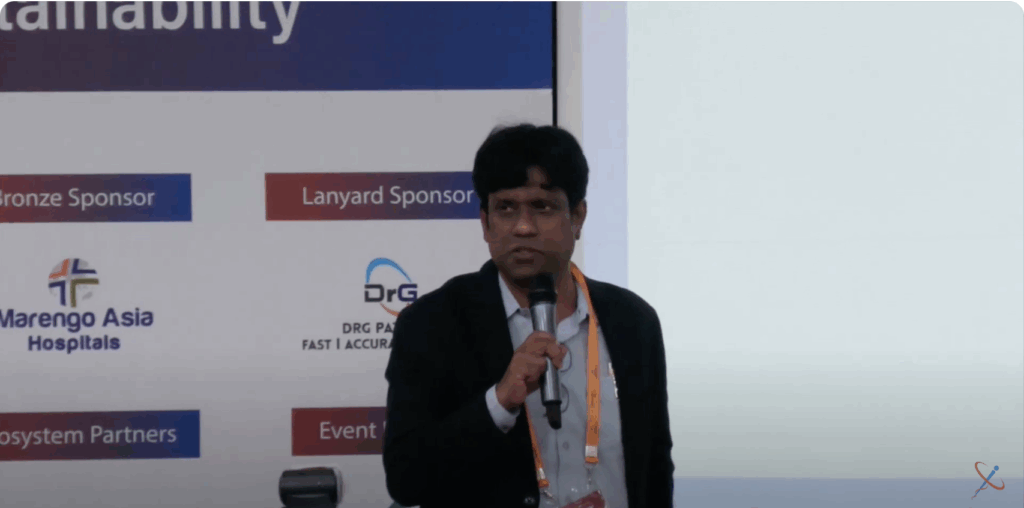
Session 3-THE SHIFT IN HEALTHCARE AI: From CNNs to Foundation Models, Vision-Language Models, & LLMs
- October 13, 2025
- 11:47 am
This transformative session, "Shifting from CNNs to Foundation Models, Vision-Language Models & LLMs in Healthcare AI," explores how artificial intelligence is reshaping medical diagnostics, patient care, and predictive analytics.
This session explores the future of AI in healthcare, focusing on how intelligent systems are reshaping patient care and medical research. It highlights the role of AI in real-time patient monitoring and personalized treatment strategies that improve outcomes and efficiency. The discussion delves into the potential of quantum AI to accelerate discoveries and enhance data-driven medical research. It also examines how AI-driven automation is streamlining clinical workflows, reducing errors, and improving productivity. Ultimately, the session emphasizes how predictive analytics and machine learning are transforming healthcare into a more proactive, precise, and patient-centric ecosystem.
Summary
From Quantum Models to Clinical Impact: The Expanding AI Horizon in Healthcare
Table of Contents
- Introduction
- Meet the Panel
- The Evolution of AI in Healthcare
- Session Highlights
- Panel Reflections: Collaboration, Ethics, and the Future
- Conclusion
- Key Takeaways
Introduction
Artificial Intelligence has moved far beyond research papers and pilot projects—it now stands as a core pillar in shaping modern healthcare. The session “From CNNs to Foundation Models: Vision, Language, and Beyond” at the InnoHealth 2024 Conference brought together pioneers working at the intersection of quantum computing, medical AI, nephrology, pediatrics, and radiology.
Moderated by Dr. Vasanth Venugopal, Chief Medical Officer at Carpal AI, the panel explored how AI’s evolution from convolutional networks to large and small language models (LLMs & SLMs) is redefining diagnostics, workflows, and patient access—while keeping ethics and empathy at the core.
Meet the Panel
- Moderator: Dr. Vasanth Venugopal, Chief Medical Officer, Carpal AI
Cardiologist and clinical AI leader specializing in radiology automation and validation.
Panelists:
- Dr. Tarun Kaushik, Medical Director, Fresenius Medical Care
Senior nephrologist integrating AI for dialysis care, patient monitoring, and clinical prediction models. - Dr. Chavali Seshadri, Senior Researcher and AI Technologist
Presented on Quantum Machine Learning—linking physics, computing, and medical data analytics. - Dr. Arthi Pawaria, Senior Consultant, Pediatric Gastroenterology & Hepatology, Amrita Hospital
Clinical innovator using AI to personalize pediatric liver disease care and remote consultations.
Together, the group represented the full spectrum of AI maturity—from theoretical models to bedside deployment.
The Evolution of AI in Healthcare
Opening the session, Dr. Vasanth traced the journey from CNNs (Convolutional Neural Networks)—which powered early diagnostic imaging tools—to foundation models and vision-language systems capable of understanding multimodal data.
“A few years ago, we talked only of radiology AI. Now, the language has changed—from imaging to intelligence, from models to meaning.”
He noted how healthcare’s AI conversations are rapidly expanding beyond imaging to include text, voice, and patient-generated data, forming a more holistic and equitable model of care.
Session Highlights
Quantum Machine Learning: Computing at the Next Frontier
Dr. Chavali Seshadri delivered a deep-dive into Quantum Machine Learning (QML)—the next evolutionary leap combining quantum physics and AI.
He explained how quantum principles like superposition and entanglement allow systems to process multiple possibilities simultaneously, dramatically increasing computational efficiency.
“If classical AI is a car driving a road, quantum AI builds infinite roads at once—and chooses the optimal one instantly.”
Key insights from his talk:
- Quantum 1.0 led to lasers and transistors; Quantum 2.0 introduced entanglement and teleportation; Quantum 3.0 merges machine learning and computation.
- Quantum models can enhance pattern detection, feature extraction, and data encoding for complex biological data.
- India currently operates small 3-qubit systems—far from the 1000-qubit threshold—but major strides (IIT Mumbai, IISc, IBM) are closing the gap.
- Quantum computing could reduce compute costs and unlock scalability for deep medical AI models in 20–25 years.
Dr. Seshadri’s futuristic view positioned quantum-enhanced healthcare as the bridge between biological complexity and computational precision.
AI in Nephrology: Predicting, Personalizing, and Preventing Kidney Failure
Dr. Tarun Kaushik showcased how AI is already transforming renal care—from dialysis monitoring to predicting vascular complications.
Fresenius Medical Care manages over 300,000 dialysis patients globally, integrating AI to optimize dosage, detect access issues, and improve survival outcomes.
Highlights from his segment:
- Predictive models identify vascular access failure, infection risk, and hospitalization probability with over 80% accuracy.
- AI-assisted algorithms now personalize erythropoietin dosing, reducing drug use and stabilizing hemoglobin variation.
- Smartphone-based image analysis detects early signs of fistula rupture or narrowing.
- Benchmarking tools compare dialysis centers’ outcomes globally, helping clinics reduce two-year mortality rates.
“AI isn’t replacing care—it’s making every decision more informed, consistent, and timely,” said Dr. Kaushik.
His presentation exemplified AI’s tangible value: saving lives by optimizing processes in one of medicine’s most resource-intensive domains.
Pediatric Hepatology and the Human Side of AI
Dr. Arthi Pawaria brought emotional depth to the discussion—focusing on AI’s role in bridging access gaps for children needing specialized liver care.
She recounted scenes from outreach programs where families travel hours for five minutes of consultation, emphasizing that AI can reverse this flow—bringing care to the patient.
“Why should patients always come to us? Technology must help us go to them.”
Her vision highlighted AI’s empathetic application:
- Speech and language models for rural teleconsultations.
- Automated note summarization and decision support for overworked pediatricians.
- Predictive models identifying children at high risk for transplant failure or survival challenges.
- Integration of patient history, imaging, and genomics for truly personalized pediatric care.
She concluded powerfully:
“AI will not replace empathy—it will amplify it. The goal is not new healthcare, but better access to the existing one.”
Panel Reflections: Collaboration, Ethics, and the Future
The closing discussion, moderated by Dr. Vasanth, emphasized collaboration between clinicians and engineers as the next frontier.
Key reflections included:
- Data stewardship must improve—medical data remains fragmented and underutilized.
- Problem-first innovation: Solutions should emerge from clinical pain points, not abstract tech possibilities.
- Patient-centered ethics: Every model must be tested against real human outcomes, not just accuracy metrics.
- Training the next generation: Medical students and data scientists must learn together, bridging the gap between insight and implementation.
Dr. Pawaria summarized it aptly:
“Build solutions with doctors, not for doctors. Only then can AI truly serve patients.”
Conclusion
The panel’s journey—from quantum physics to bedside empathy—captured the full arc of healthcare innovation.
AI, in its many forms, is not just about computation—it’s about context, compassion, and continuity of care.
From dialysis algorithms and radiology automation to predictive pediatric care, the message was clear:
AI is not the future of medicine—it is medicine evolving to meet the future.
Key Takeaways
- Quantum + AI = the next frontier in computational healthcare, promising exponential speed and precision.
- AI in nephrology demonstrates measurable clinical benefit—optimizing therapy, predicting complications, and extending survival.
- Pediatric care and telehealth show how AI can decentralize expertise and reduce healthcare inequality.
- Ethics and empathy must evolve alongside algorithms to maintain human trust.
- Clinician–engineer partnerships are essential for sustainable, real-world innovation in healthcare.
Raw Transcript
[00:00] Thank you.
[00:20] care AI from CNNs to foundation models, vision language models and LLMs. So that today's panel is going to be one of the most transformative forces shaping the future of health care artificial intelligence. The last few years have seen AI shift from a.
[00:40] promising concept to a powerful reality, fundamentally changing the way we approach everything from diagnostics to patient care. This technology is not only enhancing the precision and efficiency of medical practices but also opening new doors for personal
[01:00] care, predictive analytics and equitable healthcare solutions. Today let's dive into the profound implications of these advancements, exploring both the incredible opportunities AI brings and the challenges it presents.
[01:20] We are the panelists now. First we have Dr. Vasanth Venugopal, Carpal AI. He is our session moderator. Dr. Venugopal is a seasoned cardiologist with over 15 years of experience known for his pioneering work in integrating AI into radiology.
[01:40] He serves as the chief medical officer and clinical product lead at Carpal AI, a leading platform for validating and integrating AI solutions in the radiology field. He is also the OGE, as I've been told, of AI learning, the original gangster, and we have a
[02:00] here with us today and I am sure you will be ready to share a lot of insights with us.
[02:20] impressive academics research background having published over 150 indexed publications and delivered more than hundred lectures and CME events and conferences. Our next panelist is Dr. Tarun Koshik, Franice C.
[02:40] medical, Fresenius, am I right sir? I mispronounced it a bit. Fresenius, thank you so much. So Dr. Taran Koshak is an experienced senior consultant and a medical director at Fresenius Medical Care. Did I get it right sir? This time? Okay. With a strong background in clinical research, medical education is a big part of our work.
[03:00] education and healthcare services. With a demonstrated history of working in hospital and healthcare industry, Dr. Koshik has honed his expertise in delivering high-quality medical care, particularly in the areas of medicine and hospital management. He is asking me.
[03:20] to stop every one second for a picture. I don't know why. I feel a celebrity.
[03:40] with the people of Delhi. He has been senior postdoctoral researcher at the Indian Institute of Science, Bangalore and a postdoctoral associate of Nobel Laureate. Previously he worked with Ministry of Human Resource Development, Government of India on competency-based learning, differentiated
[04:00] Caricillum and Experiential Learning submitting a report that fed into the formulation of National Education Policy 2020. Our fifth speaker of the day is Dr. Arthi Pavaria, Amrita hospital. With the few people that we have,
[04:20] Here we can still share for our panelists. They'll still be the same. Dr. Adi Pavaria is a senior consultant in pediatric gastroenterology and the clinical lead for pediatric hepatology and liver transplantation. She is currently serving at Amrita hospital, Faridabad. Please give a huge round of applause for all our panelists.
[04:40] This is going to be a very engaging and interesting session. Keep the energy flowing please. Thank you.
[05:00] We're doing the same session. So I didn't think that in one year our interest changed so practically. In fact, in the last year talking about devas, so we talked about CNN's radiology AI platform. And now several meetings that we've moved to talk about traditional CNN.
[05:20] So these have changed quite rapidly and it's changed in the way we like it. If you don't follow the techniques, if you are not following, you will see.
[05:40] and the updated privacy. But currently we have four other conditions, and we have one very interesting personality from the future. We are just bringing it upon what's going to be the future, quantum engineering. And I don't think people are very aware of one.
[06:00] what's happening there, what are the problemships. So if you talk about that, if we have Robert De Levo, who is a dear friend of the radiologist, and we have an anthropologist and a pediatrician also on the panel today. Unfaringly, the conversations around AI in healthcare has been hijacked by the radiologists so far.
[06:20] If everyone talks about TB, MS, TB, lung cancer, breast cancer, that's an effect. But what has happened is that the instruments in the lungs, people are now looking at different use applications in different cases. That's what we're going to do here today from different regions of the panel. Now, one quick update, Dr. Ditelje, this is five years old.
[06:40] So, what we are going to do is first you hear some of the differences with future, it is fundamental how it is going to change. Probably ask him a few questions and then we can do the session as you say.
[07:00] Thank you.
[07:20] So it's side-pass to get it up from there. But I think one of the ways to do that would be that what I'm going to discuss today is very important on the national and international scene. Just to give you a little bit of context. The 2024 Nobel Prize was shown here when I went to centre of the Ontario.
[07:40] And it is called Human Networks. The 2022 Nobel Prize for Physics was for quantum entanglement. And when you bring the two together, 2022 and 2004, and some of this in each of those, then you get certain parts of quantum machine learning. So that's a step in quantum of the international scale.
[08:00] In terms of the Indian scenario, somebody was mentioning, I think Dr. Jada was mentioning about this 1,000 crore campus fund for excellent seniors for excellent TIA. You all may be familiar with the national contribution, some of you at least have heard about it. That's about 6,000 crores and it stands in the next five years.
[08:20] years. So putting them together you can see the magnitude of support and interest that the Government of India has as we see today. So now the thing is my talk will be a little bit of an introduction on various fast computational learning.
[08:40] So, we are not going to be away from what the rest of the receiver that we speak will cause because we have to develop a bit of context as to what we are talking about. What is quantum machine learning? Why is the quantum side so useful? How does it come into the picture? So, without further ado, so, actually, I will be talking about OG Swenin history.
[09:00] So the original game changes, I call them, not the giant stars necessarily. So in the quantum domain, these were the OGs. And so physics, as we view it, here in the 20th century, was fairly digested with what at least not ran in itself.
[09:20] Everything is found, right? It's not known yet. It's not known yet. All the laws are named. It's just about implementing them after such accuracy. That was a change. That was around 1894. Actually it was Mickelson or Ravi. It's still on that. Anyway. So in 1905, there was a very well-known gentleman by the name of Arun.
[09:40] Einstein. He produced or published four papers which were acceptable papers looking at relativity, looking at photoelectric effect and in one of his paper which is the photoelectric effect he found that particles or systems in the level of very small scales, we were talking about
[10:00] electrons or particles of that order, we find that nature is very different from what we have in the classical sense. So many of you may have heard about this in the popular science talks for instance. So the idea was that nature was no longer deterministic. So determinism means that you have a set of
[10:20] You have certain axiomatic premise and then thereafter you can know exactly what the state of the system would be at any point in time. But in this case there was a little more of an element of chance, a probabilistic element that came in. So these four finds people that I have shown out here
[10:40] contributed to the understanding of nature at that fundamental level. I don't want to go into too much of a physics class here, but there are certain aspects which some of you may have come across, the uncertainty principle for instance. No set of variables, a certain complementary set of variables can completely define as a standard.
[11:00] are to a certain uncertainty constraint, so to say. Then there is the idea of the wave-particle duality. There are some very paradoxical aspects like a particle or system can be both a particle as well as a wave. That is something which does not quite make sense. How can something be both a particle as well as a wave? But it just so happens that it is not a particle or system.
[11:20] happens that in certain contexts that is the case. When you have things on quantized gravity and Schrodinger equation, Schrodinger equation of course tells you about time evolution. So just to kind of go over the work, you can see we have done some very similar work, so we say. Okay, now there are three quantum revolutions that we have.
[11:40] must acknowledge. There are three revolutions which happened over the last 20-40 years. The first revolution is that of quantum 1.0. So when the quantum domain was found in the early 1900s, their application for that started a little later when borrowing shop near numbers.
[12:00] For instance, started with the transistors and then the laboratories. In the year when we had robotics independence, 1947, and then we got that in the year 1956, then you have the idea of the laser. Radio molecules come across the laser. We utilized many different areas. So that was also found roughly around 1956.
[12:20] 1958, is among the second, yes, and there was also another one in 1960. Now, 1.2.0, what was that? 1.2.0 was when he started using something which Einstein called spooky action at a distance. Right? Sathin drove, god, he goes sleep in some kind of a bed, like something which he cannot explain.
[12:40] in terms of things you understand from the get-go. So as you call it, spooky action-adexistence. What does this mean? That if you are using information that returns, if there are two carriers of information and they are correlated in manner, whereby its spatial separation doesn't change the correlation, it still remains.
[13:00] That is something which is often called as quantum coordination or entanglement. So, entanglement was something which Albert Einstein got for and rather he got for with the idea that he has to negate it. He did not buy quantum mechanics and this idea of chance. He said God does not do anything.
[13:20] There is something missing which we have to find as such. So, there was a lot of debate on that. I do not know going too much detail on that as such. But at article as you see, Einstein attacks quantum theory is something which is quite popular and some of you may have found out about that. Okay, this is one of the experiments where we have to find out about quantum theory. So, we have to find out about quantum theory. So, we have to find out about quantum theory. So, we have to find out about quantum theory. So, we have to find out about quantum theory. So, we have to find out about quantum theory. So, we have to find out about quantum theory. So, we have to find out about quantum theory. So, we have to find out about quantum theory. So, we have to find out about quantum theory. So, we have to find out about quantum theory. So, we have to find out about quantum theory. So, we have to find out about quantum theory. So, we have to find out about quantum theory. So, we have to find out about quantum theory. So, we have to find out about quantum theory. So, we have to find out about quantum theory. So, we have to find out about quantum theory. So, we have to find out about quantum theory. So, we have to find out about quantum theory. So, we have to find out about quantum theory. So, we have to find out about quantum theory. So, we have to find out about quantum theory.
[13:40] which were done for finding this idea of entanglements in the laboratory. This was the experiment which was the 2032 Nobel Prize at work. The idea was that these two particles that you see out there are inter-corrected or coordinated in a very specific manner, and that time you detect it using what was known as coincidentity.
[14:00] So again that's really too much of a physics phenomenon, but just your highlight importance of this. And quantum entanglement has been found in labs. So you see this very interesting shape on the right hand side. So there are different sets of lines that have hit the screen there, which are both at the top of the figure. And so each of these lines have been found in labs. And so each of these labs have been found in labs. And so each of these labs have been found in labs. And so each of these labs have been found in labs. And so each of these labs have been found in labs. And so each of these labs have been found in labs. And so each of these labs have been found in labs. And so each of these labs have been found in labs. And so each of these labs have been found in labs. And so each of these labs have been found in labs. And so each of these labs have been found in labs. And so each of these labs have been found in labs. And so each of these labs have been found in labs. And so each of these labs have been found in labs. And so each of these labs have been found in labs. And so each of these labs have been found in labs. And so each of these labs have been found in labs. And so each of these labs have been found in labs. And so each of these labs have been found in labs.
[14:20] those dots and the complementary dot in the other thicker, let us see, so there are two circular figures right, so the specks, two of them are complementary to each other and they have this connection, this interconnectedness which is important, the co-remations so to say right and that is a resource which is used in quantum information which will become important.
[14:40] So now when quantum entanglement was found, there are a few things that are very interesting and exciting. So one was, some of you may recognize that scene from Star Trek, which is that of anyone? What is happening in the scene from Star Trek?
[15:00] teleportation right so the idea was that somebody can vanish from someplace and turn up appear somewhere else so that was very fascinating now quantum entanglement happens to give you a way to do quantum teleportation it's not quite what started had in mind
[15:20] unfortunately, are you safe, but it is what it is. And so there are many different things that we can do with this idea of quantum entanglement and the resources that the quantum systems get to us. For instance, quantum cryptography. When we have to send encoded information across vast distances, recently we
[15:40] project by ISRO and a few other Chinese universities as well on that side and then American universities towards the west that have been trying to see how we can send encoded information across vast distances on the surface of the Earth as well as on the surface to satellite so to say. Right? So quantum in-time
[16:00] What it does is that it helps us in connecting very different parts of the world. It is something that connects vast distances and the definition itself. Also, point-of-the-systems have something which is known as superposition. Superposition means that one system can have multiple states at the very same time.
[16:20] So, let us say that we have a function of 0 and 1, right? So, let us say that we have a function of 0 and 1, right? So, let us say that we have a function of 0 and 1, right? So, let us say that we have a function of 0 and 1, right? So, let us say that we have a function of 0 and 1, right? So, let us say that we have a function of 0 and 1, right? So, let us say that we have a function of 0 and 1, right? So, let us say that we have a function of 0 and 1, right? So, let us say that we have a function of 0 and 1, right? So, let us say that we have a function of 0 and 1, right? So, let us say that we have a function of 0 and 1, right? So, let us say that we have a function of 0 and 1, right? So, let us say that we have a function of 0 and 1, right? So, let us say that we have a function of 0 and 1, right? So, let us say that we have a function of 0 and 1, right? So, let us say that we have a function of 0 and 1, right? So, let us say that we have a function of 0 and 1, right? So, let us say that we have a function of 0 and 1, right? So, let us say that we have a function of 0 and 1, right? So, let us say that we have a function of 0 and 1, right? So, let us say that we have a function of 0 and 1, right? So, let us say that we have a function of 0 and 1, right? So, let us say that we have a function of 0 and 1, right?
[16:40] can be manipulated, they can be broadcast, can be controlled and distributed as well. Now this is an interesting slide because this is where quantum computing adds a field kind of scheme into the E, these people who have been shown here. The first one is Horevo. Horevo bound is basically the amount of information
[17:00] a quantum system can send which is more and above its classical counterpart. It is basically a bound of sorts for the quantum information efficiency over its classical counterparts. Then you have many of the sponsored Turing machines. There are Turing machines that have been found which have a quantum size in range in it.
[17:20] It is a very interesting process. It is a very interesting process. It is a very interesting process. It is a very interesting process. It is a very interesting process. It is a very interesting process. It is a very interesting process. It is a very interesting process. It is a very interesting process. It is a very interesting process. It is a very interesting process. It is a very interesting process. It is a very interesting process. It is a very interesting process. It is a very interesting process. It is a very interesting process. It is a very interesting process. It is a very interesting process. It is a very interesting process. It is a very interesting process. It is a very interesting process. It is a very interesting process. It is a very interesting process. It is a very interesting process. It is a very interesting process. It is a very interesting process. It is a very interesting process. It is a very interesting process. It is a very interesting process.
[17:40] cannot be closed. That is a very interesting fundamental result and this gentleman I had the privilege of interacting with him myself, Jayan Deutsch. He is the first, he did the first universal quantum computer in 1985. So he is one of the very well known kind of figures in this area of research.
[18:00] So I saw on the right hand side what I've already mentioned, which is superposition as such, which is you can have multiple states at the same time for one system, which is a very important resource. And then we can also have quantum computation using the coordination that we were discussing about. So I'll be expecting on that a little bit. So the question is, what is the problem?
[18:20] quantum 3.0. So the idea is that if you can integrate these two very important areas of research which is kind of quantum computation and machine learning, then you get something by the name of quantum machine learning. Now the point is how do you do that? So if I were to ask you what are the
[18:40] So these are the different elements that are important in machine learning as such. I mean the basic kind of elements that we need. Data. Right. Anything else? The computation process. Right. The different elements that help with the transformations and the computation process. Right. So primarily those two. Right. So we basically have data. Right. As such. Right. Right. Right. Right. Right. Right.
[19:00] And we have the computation methodology, the elements, the transmitted kind of operations. Now, quantum computation and machine learning comes in three definite ways. One is if you have what is known as classical data, but a quantum model. What does that mean? If you want to have the machine learning analogues
[19:20] machine learning protocols that you have and you learn to make it into a quantum computing analog. How do you do that? So there are different kinds of gate operations we often do in classical computing. So there are analogues of that in very specific ways which have been developed for algorithmic purposes. For instance,
[19:40] algorithm is a very valuable one, those algorithm is available and so on and so forth. Then you have something by the name of quantum data itself. The data itself is represented as a quantum system or a state. So that is quantum data, but a classical model. You can also have that. And the last one is of
[20:00] If it was classical data and classical model, does it make any sense? Is it anything new? Not quite, so what is there? One of them is data and polymorphic. So if you have, for instance, adversarial networks or various signs of neural networks as well, which are quantum in nature in the modeling, as well as data which is represented by a system.
[20:20] So, we have to have a system that is represented in terms of quantum systems, then you have
[20:40] scenario where you have classical data and quantum body. So an example has been given for QML out there. So you have data encoding. Now data encoding is done in terms of a spiner. As we know, I am not going to mathematics of that. It is something which is used for quantum system representations. So if you want to have
[21:00] data encoding with the spiner, there are ways in which you can extract features from that. They are very definite manner, for instance, a subsection of the features using projected measurements. You can project a surface-wandered system into a basis of different formulae states, so state. Thereafter, get some information from that.
[21:20] So, you have some kind of gauge, so there are many different kinds of gauges that can be used. Then you have the measurement which is done. Now as some of you may know, eight quantum systems still you measure the system, right? That is the problem is that it is very much present.
[21:40] Let us say is there any problem with the system? Changes. Changes. Is it a problem? Yeah, well it changes, but it kind of assumes one definite state. It has a multiplicity of states and as soon as you measure it, there is one state that it collapses into. That is the argument. So, if you measure the system, what happens? Let us say is there any problem with the system? Changes. Changes. Is it a problem? Yeah, well it changes, but it kind of assumes one definite state. It has a multiplicity of states and as soon as you measure it, there is one state that it collapses into. That is the argument. So, if you measure the system, what happens? It changes. It changes. It changes. But it kind of assumes one definite state. It has a multiplicity of states and as soon as you measure it, there is one state that it collapses into. That is the argument. It changes. It changes.
[22:00] So, the useful information has to be got from the measurements. It cannot be in the super-cold state because superposition needs that the multiplicity of states are still existing. So, basically at the end you have these decoders or measurement units that are utilized. In different systems you have different types of measurement units.
[22:20] systems, superconducting system and so on and so forth. So, we are not going into that all that much. And then finally, you have something, you have many different kinds of organisms. So, you have the QSEM, support vector machines. In that you have transformations for which they are mentioned in the mineral rectangles. These are again military transformations that
[22:40] have different parameters that have been embedded. It's a phi. You see a phi there, right? It's a phi. And the idea is very simple actually. So what does a support vector machine do technically, fundamentally? There are, it's a, can we talk about dot products or distances?
[23:00] So, you see in the minute there are two rectangles X and Z is the parallel X and Z right. So, there is a interrelated kind of transformation that happens right which is contingent on the value of X and Z in that case right. So, there is a way in which the supply is not
[23:20] vector machine, part of it is undertaken by the unitary transformation on the module sign. That's an important aspect, I think more or less others we have covered. This is something which is quite involved, so I'm not going to do too much detail on that. It's the support vector machine again and this is an actual implementation of modus problem.
[23:40] The idea is these gates that you see, the pink ones are rotation gates. So there are three axes, X, Y and Z. So there are different kinds of angles by which you can transform or you can rotate a certain quantum pitch, carrying out information. And there are some, you see these transformations that are there.
[24:00] are connecting two different what lines these are all control operations right so when you have let us say 0 on the first wire nothing happens from the second one and 1 if you have on the first one there is some different transformation that happens with the second one right. So, you do not have to go into one from the map the idea is this is what you are seeing here in that line to the side it is being represented
[24:20] There is a projection measurement, there is a distance aspect of it which is being found between something which is represented by the X-prime, you can see the X-prime on the top, and an X on this side. So it's a little different, you can see it. So there is a way in which the distance, I would say, is found in terms of information carriers.
[24:40] I just quickly go over the quantum neural networks. You all know how the basic structure of an acicle neural network. So in the quantum neural network, you have these unitary transformations. So you want neutrino neutrins. These are all quantum neutrins in this case, and they are used in a cascade manner. Now it's very important to understand that.
[25:00] In quantum logic, there is something called as non-communicability. Non-communicability is not that the ordinary is very important. The way in which you make the ordinary is extremely crucial. And so you see there's a very definite order. If I ever change that, there are many different scenarios and results that you can get from that if you want to play around with the post.
[25:20] unitary, so to say. And then you have things like the nearest neighbor model, the idea is that you can again compute distances. In this case, it is something known as the controlled soft weight. What is a controlled soft weight? What is a soft weight?
[25:40] So, if you take one as a control and then you swap the other two alpha and beta. Now, the alpha and beta are basically what you are finding the distance between the second one.
[26:00] That's the carrier of the information you're requiring in the QKNN model, but that's not enough. After you have found the distance, you have to do something known as a minimum distancing or minimum distance finding, which is done by the Grover's algorithm. You can find the minimum in a set of values using something known as the Grover's model.
[26:20] algorithm. I'm not going to do too much on that, it will be an action itself. Quantum R
[26:40] And a little bit of efficiency as well. There are many other studies you can see here, which is in terms of clustering, of auto encoders. So the idea again is how do we change the representation of the state as well as the transformations and the efficiency and speed-up that happens because of that.
[27:00] primarily because of the state-state expansion as well as the methods of parallelism. What is parallelism anyone? Parallelism is when you can do multiple things in parallel, there is a parallelistic aspect to it. So if you want to be able to do that with quantum systems, that can help in computation.
[27:20] So I leave it at that and I am happy to find this answer.
[27:40] than now, seven months ago. How to play is powerful, you can handle a lot of data, it's secure. Today one of the biggest portal is the availability of compute and cost of compute. Do you think it will get better with application of quantum unilever?
[28:00] is it still going to be much more expensive than what we are looking at today.
[28:20] There is something known as deep currents, which is that it's quantum systems lose their quantumness, right? Quantumness because of co-inflation as the system develops with the environment, right? So in a way it's very important to protect the system as such, right? So that is done by many different ways, temperature, pressure, various aspects on that.
[28:40] as well as algorithmic ideas as well like deep over-entry subspaces in mathematics that we utilize. The point being that to make a simple quantum computer, okay, let me ask you, how many qubit systems do you think in India we have as such today, as you see? Anybody guess? So I'll give you a kind of threshold, basically.
[29:00] So, that you can pick that based on that right. So, 1000 qubits makes a proper fault tolerant quantum computer right that is what is that is said to be one of the marks where if we cross 1000 right then we can have what is known as fault tolerance right. How many do you think in TI I found Mumbai is another good working side not mentioned that. TI is 1.5 million.
[29:20] On the side of Mumbai, on the same institutions, what is the limit we have reached in now? Any ideas? Any guesses? Yes? Okay, have a much switch of questions. Okay, let's go by orders of 10. 300, 300, 300.
[29:40] So we have only three qubit quantum computers still now. They are not even quantum computers. So I say they are just computation systems which kind of does certain operations so to say. In the mess in the US, we have 150, 180 petals per head. But they are still very far from 1,000 qubits. So the point is that it is very difficult.
[30:00] And it's not going to help. But having said that, IBM, you all are struggling with IBM as well. They have something known as quantum experience. You all can kind of go to the left side and you can actually do calculations on a quantum computer. And schedule your tasks on a quantum computer. So if we can have quantum machine learning with remote sources that now compute it, for instance.
[30:20] There could be an image that can be done potentially. Just one quick question before I let you go. When do you see the sediments? Like the CNNs, eulogums, transformers, gans. When do you think it will be a must-do? Again, you know, rough numbers, 5 years, 10 years. They quantum.
[30:40] answer. So I would say that the only way it's there is where it's on that. But then I was showing the exact eye on human-conscious consumers that it's still not a widespread thing that is still in selective cases where it's happening. So I would say at least 25 years after the
[31:00] kind of get significantly ahead, at least at some point in time, we are going fairly quickly and in a slow way. Thank you so much. Thank you. Thank you very much. I think next I will invite Dr. Tauru to talk about his work in the area of nephrology.
[31:20] The higher of the regime carrier is still part of the methodology, and that means the split radiology and movement in this community, and various joint industry. Let's hear about the problem for what is doing in this case.
[31:40] I'm almost leading off the transition as well. So my name is Chavil Sarshik and I'm currently working as a manager for Social Media, mental care. This is a company which is a market leader in dialysis-free patients with severe behavior here at dialysis.
[32:00] In the world, they have about 300,000 patients in the sense of mobile home addresses and we see in about 50 countries in about 4,000 countries. We have a very small part of it. We just have our own particular community that's expensive. But at the same time, they manufacture the hardware.
[32:20] for the benefit of the individual. And it is also a benefit that we will see. So the stool is unlike everybody here, and not any expert on the data. So it is an internship, leadership, TV special. Consider me as an end user, obviously, about all of the work. All the work I am going to show here is just by coming.
[32:40] And for every dose, we lose this big E, and I'm just looking at it. So quickly, what is the analysis, the common question asked from all of you is, when any strain is called COVID-19 disease, and for you to know, you pass here, you pass excess water and
[33:00] We have an imbalance of vitamin D and bone metabolism making into an infectious and infectious disease. And we have a imbalance of vitamin D and bone metabolism making into an infectious disease. And we have a imbalance of vitamin D and bone metabolism making into an infectious disease. And we have a imbalance of vitamin D and bone metabolism making into an infectious disease. And we have a imbalance of vitamin D and bone metabolism making into an infectious disease. And we have a imbalance of vitamin D and bone metabolism making into an infectious disease. And we have a imbalance of vitamin D and bone metabolism making into an infectious disease. And we have a imbalance of vitamin D and bone metabolism making into an infectious disease. And we have a imbalance of vitamin D and bone metabolism making into an infectious disease. And we have a imbalance of vitamin D and bone metabolism making into an infectious disease. And we have a imbalance of vitamin D and bone metabolism making into an infectious disease. And we have a imbalance of vitamin D and bone metabolism making into an infectious disease.
[33:20] And there is a very high mortality associated with it, particularly more so in India. We are very inversed in a lot of cancers due to RDPs and so on. Interestingly, 22% of our 1.4 million population in India is at risk for developing immunity. That is another video format of care.
[33:40] Most people who are direct overlap of that is hypertension. So it is coming close to very soon. So what can be an sticky period? Again in terms of preventions, we are here at the very recent state. So if we find early phases of sticky period, the gradually changes.
[34:00] like antigen and of course medications to slow down progression. Then we give almost injections like electropoietin to stimulate the number to produce the number. Most important thing about ESOL is that this hormone is typically required very high dose of electropoietin.
[34:20] maintain a circular level of hemoglobin that makes you hopeful for developing arguity of source. In advanced stages of petit-frenetic required diagnosis, diagnosis is nothing but a process of infinitive learn-out culture. This is the diagnosis circuit.
[34:40] So the blood comes from patient's body. It's a mediacas, it has a florid around 400 nanosolids. We run it through a filter on the diallitis, where the toxins are filtered out and the blood is filtered. So this process happens for 4 hours, 3 times a week.
[35:00] can get the next two analysis units in the machine for 12 hours or weeks. And that's the only data it's connected in terms of the amount of people right in parameters. Left parameters, now more than machines are even too in a nice load of left parameters, with another radius of hemodynamics.
[35:20] So this is what happens in a process of memory. So excess for the most important aspect of the treatment in this the blood is removed from the patient, ran to the intranet.
[35:40] So, what we do is we connect one artery to a vein in the wrist or in the elbow and then the vein gets bigger and bigger eventually.
[36:00] It's big enough to have good effective blood flow for 12 hours per week. But the problem is when this waste continues to get big, it may become analytically big in size, it may get narrowed up, it may get narrowed up like a blood clot in it, or it can just, gaseous of blood.
[36:20] So, it is very important that we monitor the slide line of the patient on dialysis. So, that is why the monitoring, excess monitoring, hemoglobin assessments, epomonetal is all coming into place. That is what makes it important for us to adapt this machine learning model.
[36:40] problems at all sooner than other beautiful illnesses. This is how it looks like in real life. There's one which is one middle school is taking over the learn and another one is talking about in meditation to don't balance this. It's called in Vishnu, there's another called balance is called pay to hear analysis.
[37:00] So the immunoglobulin people, that is one of the problems, but it is quite effective at managing the source for the illness. So there are always, in medical circuits, where people are not very AI-savvy, they say, is there an executive promise of the AI in healthcare?
[37:20] But I believe Dallas is still a great success story with the use of care in beds, providing a bedside care to the patients. So the main challenge is that the kidney care is the impact on patients' quality of life.
[37:40] These patients that took on free time to re-imagine. And then we add on the dietary restriction as well with various base on their health and their medical history. So this is a very prominent US law writer. She once mentioned that.
[38:00] And then the synthesis does not make patients where it simply goes from there to there. In normal time we are all there, but we are trying to make it better in terms of quality of life and in which technology is playing a significant role in what we are trying to do, particularly in social media. So there are a lot of labors who improve immunization.
[38:20] So, most of the models algorithm in the legal world which I am using or planning to use
[38:40] It does not need that much of data and the strength of this mortality that is excellently unlike AR and weaknesses that.
[39:00] one needs to understand the physiology very well to the other people. So we have been successful in understanding geology in some aspects of human body. So this is an international portfolio among various fitness, sitting care centers across the globe.
[39:20] Then, prognostabismic tools and other prior systems. And again, therapy management models like ACA, which is an Indian computation model, which will help us in deciding the habit properties of all those, and how the sheep of those will become attained with that.
[39:40] And we are using other models such as patient-reported outcome models, froms, you call them, because that now suddenly we are realizing that what patients use is also an important treatment outcome rather than just survival, hydrology, all that treatment. So in use of this, we are using other models such as patient-reported outcome models, froms, you call them, because that now suddenly we are realizing that what patients use is also an important treatment outcome rather than just survival, hydrology, all that treatment.
[40:00] As my colleagues are using mainly a demodern social work in dietitian equity schools, in dietitian equity schools we provide them information and coding system based on 30 to 40 dynamic patient data which is somehow weekly and they can decide about the physical diabetes.
[40:20] as well as diet recipes, work with the enders and work with our people. And also, the prognostic recent post- and cryo-systems where you live in ariyat kishla at least close because it's a lifeline for that kishla, the blood source of the patient. Then finding out which patients who are coming to the end.
[40:40] And then the other thing is that the hospital can do well at home. Then what is most interesting is that there is imminent hospitalization. So this is something of quite an ease in terms of patient management and it gives you a kind of a red light for a patient when they see the overall data pertaining to its immunization.
[41:00] imposterization on the relative use of the hemodilosus patient. So now the trials have been published out of AI in a nephrology journal. So this other randomized control via B-CIND came out. So in which they use a therapy-assisted software combined with epidemiology with mathematical treatment.
[41:20] model to decide about erythroporins at hormone dose to attain a certain range of hemoglobin. And it showed that we were able to reduce the erythroporin at hormone dose significantly based on these models. And the variation in hemoglobin was much less because we could attain a range between.
[41:40] tend to ill-elated amounts of immunoglobulin during their period of time. Essentially, you see in the lean side is interventions of compared to the support for looking that is tender or chiazzed. And you see that isopoid in those is consistently go two over side.
[42:00] Similarly we use vascular access failure in immunopishella failure. So the previous model we have at a multiple specific and in the next world and similarly this vascular access failure model is in plan to the immunopishella failure.
[42:20] in higher clinics in India. So it keeps up to 80% accuracy in deciding about the practitioner's related future. Similarly, there is a smartphone application being developed in which you take pictures of the analyst practitioner and it gives you a list of analytical rupture or worsting.
[42:40] Then each stenosope application is being done by anacolyse and in the book in which you put an anachronic stenosope or a fistula and it can work out the probability of stenosis being present. It's very very tight. And this is something I admire this part for.
[43:00] use of technology is advanced benchmarking because we have a high mortality in our patient group. In India, there's a paper recently published which showed that people from the patients from Dallas died at 6 months. It is pretty bad. What's the amount of cancer, the amount of access in India?
[43:20] So, what this model does is for the clinic level. So, this is our Singapore, all the clinics in Singapore. They work out the 2 year motor vehicle and the diamond part is here, they are active on the area in their region. And this is one of the clinics.
[43:40] in which the score has come out, the red bars show the correctable factors in that clinic. And it has been now kind of proven with beyond doubt that if you correct these red bars, which are a lot of correctable factors for patients, your two-year mortality in that particular clinic would come sound.
[44:00] So I think it doesn't get recognized as for a hypogonality. So why do we do this? Mainly for personalized care. We can't just skip every one of the ingredients I shared in our century there and be happy with it. And also value in terms of cost.
[44:20] efficiency of the system is very important because healthcare is very expensive to drive again. So with that, can you please stand for for a nice? Thank you.
[44:40] doing a better job than what you are going to do. So now you know I would invite Chabrati. So personally have seen Chabrati present to other clinical doctors for use a workshop on how to use fat fat.
[45:00] for clinical and research years. And I'm sure if you are seeing the industrial use, you have seen the future. And how will you see how, is it so powerful that we can actually do clinical practice and probably for research years? Thank you.
[45:20] So I have a lot of information about the paper. I have a lot of information about the paper. I have a lot of information about the paper. I have a lot of information about the paper. I have a lot of information about the paper. I have a lot of information about the paper. I have a lot of information about the paper. I have a lot of information about the paper. I have a lot of information about the paper. I have a lot of information about the paper. I have a lot of information about the paper. I have a lot of information about the paper. I have a lot of information about the paper. I have a lot of information about the paper. I have a lot of information about the paper. I have a lot of information about the paper. I have a lot of information about the paper. I have a lot of information about the paper. I have a lot of information about the paper. I have a lot of information about the paper. I have a lot of information about the paper. I have a lot of information about the paper. I have a lot of information about the paper. I have a lot of information about the paper. I have a lot of information about the paper. I have a lot of information about the paper. I have a lot of information about the paper. I have a lot of information about the paper. I have a lot of information about the paper.
[45:40] So, this is a very difficult case to find out.
[46:00] While having evolved into a healthcare scientist and be the last point of care, science was based on circuits and many other things and behalf of the term nerve, who does it? Technology is also important when it comes to it. But finally, what is the result from the patients?
[46:20] So, again the final point of care comes to the one who receives it and we in humans each one of our dear and dear ones are the ones whom needs to get a culmination of all this the best of immunology, the best of healthcare and the best of science, the best of air.
[46:40] So, I start my presentation and the way I would put it is that why after 21 years having gone vertically up into more specialized areas like after doing pediatric, side-to-side-to-side
[47:00] why I still come back to this because this picture haunts me all the time. Wherever I go, people are waiting like once a month for an outreach meeting in a remote area and mind you, remote area is remote area is only but it's not very far from the area.
[47:20] patients made their carastica once a month to produce up to there for 5 minutes and they suffer the rest 29 days. Big hours says so much of the lack of specialized care that they do not get it and hence is a migration to larger health care.
[47:40] So, how I first had AI in my mind and said how do we reach out to this population, all of them stand there, all of them for example, they take dialyzism. For example, if I say this is over about it, they have to participate dialyzism, but there has to be somebody who tells them, each one of them, okay, this is the character, this is the character.
[48:00] We have to be careful about the situation. We have to be careful about the situation. We have to be careful about the situation. We have to be careful about the situation. We have to be careful about the situation. We have to be careful about the situation. We have to be careful about the situation. We have to be careful about the situation. We have to be careful about the situation. We have to be careful about the situation. We have to be careful about the situation. We have to be careful about the situation. We have to be careful about the situation. We have to be careful about the situation. We have to be careful about the situation. We have to be careful about the situation. We have to be careful about the situation. We have to be careful about the situation. We have to be careful about the situation. We have to be careful about the situation. We have to be careful about the situation. We have to be careful about the situation. We have to be careful about the situation. We have to be careful about the situation. We have to be careful about the situation. We have to be careful about the situation. We have to be careful about the situation. We have to be careful about the situation. We have to be careful about the situation.
[48:20] do they really need to take vessels and trains and outros and metros and get on so on and on and use Google map? Use Google map to reach us but how can you not reach them? So that is where it is important and why should doctors be the ones who has to now stand up to me and say if I stand there, if I stand there,
[48:40] I just need to give it to somebody who needs it, be it the consciousness thing, be it my tithing, be it listening to somebody writing drugs.
[49:00] person on that side, all of them should have the same standard of care. So the standard of care is not being maintained even though we have a very fantastic healthcare system with anti-inflammatory disease of both social healthcare as well as private healthcare. You go to the UK, you've gone with an ultrasound today, you know, because they have emirates. You go to the U.S.
[49:20] So, this is a very beautiful healthcare where we need to set it up as usually like a medical physician.
[49:40] We do not need to make a new healthcare. So having been expiratizing mediatics, I still believe that both mediatics and adult healthcare must and merely use AI, mostly mutated ethics, which is always a new candidate. It must be used for immunization.
[50:00] So, that is how the learning the large scale learning models and the smaller one and read learning are the ones which help. So, when you put in the traditional as we said traditional AI is completely different in the networks they basically had images.
[50:20] So, what is the problem? So, what is the problem? So, what is the problem? So, what is the problem? So, what is the problem? So, what is the problem? So, what is the problem? So, what is the problem? So, what is the problem? So, what is the problem? So, what is the problem? So, what is the problem? So, what is the problem? So, what is the problem? So, what is the problem? So, what is the problem? So, what is the problem? So, what is the problem? So, what is the problem? So, what is the problem? So, what is the problem? So, what is the problem? So, what is the problem? So, what is the problem? So, what is the problem? So, what is the problem? So, what is the problem? So, what is the problem? So, what is the problem?
[50:40] So, when your traditionalist came and said that of course, you need a large, large data models to teach them and if you want it to have any change in the research practice, any change in the practice of medicine, it needs to be re-primed, which again involves a lot of money and of course, cannot be put into generalize datasets.
[51:00] So, when that happens, the new ones came which had a more generalized learning can have finer read- learning the next time and of course, will then adapt it to change it. For example, today I feel I treat or maybe 80 percent of the children with jovapelia survive with their own liver without mediocre as fine, but maybe
[51:20] 10 years back, only 10% is in the units. So what happened between 10 and 80%? Science improved, new drug, new foundation, new research is, people on the best, top to the people here and people everywhere, doctors, top to the same number. Do things improve? Do we think that those things would have easily improved? No.
[51:40] So, what they did was they did just not the images, but as well as a text written by the people as you know we saw the pictures of all your physicists and the spinetress who came there. All of them what have been there written, re-searching for a younger person like you know was born in 1985 at the first quantified site.
[52:00] So, the first contact computer was made and I was born. So, there were doctors much more difficult at what they have already talked about, cholera what they have already talked about, type or what they have already talked about, tomokillosis. Today I am not expected to read everything and then keep up with the medical research now also, neodignosis, neutemology.
[52:20] And then tell how am I going to treat the patient, the patient completely here from then. So I need to get updated immediately in a form which I can also read. Every year there are 5 human doctors who come under us. How do I tell? Do I tell them go back the way 50 years people were reading, you read? No. But how the things in group they are doing.
[52:40] When the textual information got summarized, summarized fast in the use of AI and then an automated documentation also. Managed with writing, visitation writing, if we do the same thing used one year, is that one year equal to many other things? So AI is different than that.
[53:00] does not mean AI is going to be interpretation. AI is going to be interpretation gives them your information coded into it and they understand in the system. So, however, you understand there are very various ways every individual before just of ideology is better everything that we do. The most important when it came to what the
[53:20] So, it integrated what their research or what the conceptual things about the GV was, what is there, is there a variability in that and then comes out with your inputs, your most understanding or languages as well to say I do think this looks like this, however, this could be this.
[53:40] So, the doctors, even the junior doctor got supported by a factual documentation that happened and of course, a clinical decision looking who will go for transplant, who will not know at what kinds of rates appear to be surviving completely or not and the workflow automation.
[54:00] So, when we are talking about the definition of the definition of the definition of the definition of the definition of the definition of the definition of the definition of the definition of the definition of the definition of the definition of the definition of the definition of the definition of the definition of the definition of the definition of the definition of the definition of the definition of the definition of the definition of the definition of the definition of the definition of the definition of the definition of the definition of the definition of the
[54:20] medical care which is needed, evidence based will come when you have to have 50 guidelines for one disease, how do you integrate it based on your patient data, you integrate it based on what are the clinical guidance and the kind of mutation. Along with that if a patient, if I have to start talking about patient data, then it
[54:40] patient from saying what is your name, what is your age, what is your date of birth, I like to dance here and listen what will happen then your family will say goodbye, why should a doctor be listing a family writing a book? That is exactly easily denoted. More so just not this, how long do you ask even? Is it high grade? Is it high grade?
[55:00] does it come down in this intermittent? Anything else? We have joined in May, May, do you have this? We have that. You know the industry is Ramaswami-45 minutes. When you pass your medical school, the only thing after 5.5 years they expect you to do, at least if you're in school. Think about when I'm not sure they're in jail.
[55:20] go out of this, you know, engineering college, is it? Coreally you're supposed to pick something or run some programs or run some something. His doctor and I are expected to at least make a diagnosis or a differential diagnosis, not even a diagnosis. Just ask appropriate questions and take a history and you reach out to project it, a differential diagnosis.
[55:40] treatment is not even there. But when you come to the healthcare video also, even the chief medical officer of a secondary, chief medical officer of a secondary healthcare centre is just an ambiguous. How is it expected to be the policy decision making? Medicinals in India do not do this and there is where is non-uniformic
[56:00] So, what we can do is if I if I am in a situation where I have to be in a situation where I
[56:20] specialist, someone on that side is not a specialist, they can, he can talk to AI, he can be trained through AI and it should feel not just one to one, it can just open model, please learn it, go ahead and help them. So that is what I meant by my chargeability, why is this a GP AI some advice?
[56:40] Now for example, it is six months back I was told to arguably use chaggy people to make a customized, with them about pediatric diarrhea which is loose to its own children because it has many diseases. Then I gave chaggy people some hints, some questions, I read about the patient and I saw
[57:00] give me a genetic word in this. To other people, when they Google, they make feelings of the human as well as the human as well. But actually, what it gives you today is not the one which is a god young man and beyond, it gives you fancy names because you do not influence it. For example, in the email I talked to Mr. Lian, he has just referred it all his life.
[57:20] I would still feel that everything is right. So that change is what is with my act or my act to make healthcare better in house to enhance the healthcare.
[57:40] So, what I need to do, I just need to get out of the way.
[58:00] So, if you have a patient who is not a doctor, you can have a patient who is not a doctor.
[58:20] So, hence we say that when we have a patient centric and a personalized care, it will only come when a doctor is supported by many others as the strength in terms of reading the papers, in terms of summarizing the paper, in terms of some kind of history, but he knows.
[58:40] So, I have been listening to patients some of them live, some of them die, some of them come, this is that.
[59:00] We keep telling ourselves, now there is so much experience in being able to do this, that by the look of it I know which one is going to make it, which one is not. Because the look is, I have understood another history, I know the labs, I know the genetics of this, I know this, this. As a culmination of all this, I know, will you.
[59:20] will be okay with the drug, will you be leading a transplant, will you be surviving, will not be surviving and build a, will your other family members get a degree because of it? It is a difficult ability. But I know this. By the time the patient does not reach me, he has three siblings died in the last five years before he has reached a specialist.
[59:40] So, AI is going to tell us if we can make a model and say this is a Wilson's model, please enter your data, including imaging, including history, including the lab test, including what treatment you have taken and how are you going to know and we will tell you, the model will tell you I notice, I else.
[01:00:00] So, when you do this, finally your health care will be served in the existing health care only when it is a health care.
[01:00:20] I do not believe it goes vertically up, it does not. The images still needs to be done, just it still needs to be done. It has to be much so accurate, much so fundamental. However, need of in to somebody, my blood process is written down, my narration, the patient's narration.
[01:00:40] So, it is not a good thing to do that. So, it is not a good thing to do that. So, it is not a good thing to do that. So, it is not a good thing to do that. So, it is not a good thing to do that. So, it is not a good thing to do that. So, it is not a good thing to do that. So, it is not a good thing to do that. So, it is not a good thing to do that. So, it is not a good thing to do that. So, it is not a good thing to do that. So, it is not a good thing to do that. So, it is not a good thing to do that. So, it is not a good thing to do that. So, it is not a good thing to do that. So, it is not a good thing to do that. So, it is not a good thing to do that. So, it is not a good thing to do that. So, it is not a good thing to do that. So, it is not a good thing to do that. So, it is not a good thing to do that. So, it is not a good thing to do that. So, it is not a good thing to do that. So, it is not a good thing to do that. So, it is not a good thing to do that. So, it is not a good thing to do that. So, it is not a good thing to do that. So, it is not a good thing to do that. So, it is not a good thing to do that.
[01:01:00] As the last mile where the patient is ex-in-centre near us, that's 8 per year, although they would think of them. You know, one we can give best when you always tell them. We are going to, I don't know which way to put it, but then when you have been best-old with the responsibility.
[01:01:20] of it to be extremely careful because the other person is going to listen to you, take a drive, take a drive, go there, go there, whatever. When you are doing that, you have to be supported by all the support systems so that he gets the care. So I did realize doctors are the one who
[01:01:40] get up and do this AI and all of you behind them. Caring for their last mile is always going to be difficult and hence I believe from now on they would definitely be the more is an engagement between engineers and doctors and clinicians so actually hyper-constituting them.
[01:02:00] A lot of USIs can easily develop. Thank you.
[01:02:20] We intentionally decided that we would present the needs language and just talk about our experiences. I have a couple of questions here. The first thing is, last year when discussing, we talked about the test XAI, the deployed large-scale aims.
[01:02:40] Now, we can write some notes there as a first part of the question. The second part is, again, as we see here, the chip actually happens, right? You learn a lot of new stuff about the AI, the LN, some of these things are going to be useful. In other fields, we need more outcomes and benefits.
[01:03:00] Sir, we are going to talk about why we are going to tell more about reactions. What is it about something both these ideas? Learning about development and what is different from last year? Thanks, wasn't for coming new year and last time we discussed about film at the end.
[01:03:20] So, we almost have this particular model of this photograph for I think one year now and now we started with some skepticism that whether it be worth or not because our requirement was we do not have enough regularly to report it was.
[01:03:40] We do some 1000 exams in a day and for any radiologist to do just tests, they cannot do more than 100 test exams in a day. So, you need 10 radiologists to report those 1000 exams. It is not possible you do not have any tests.
[01:04:00] kind of bandwidth, we will be wasting our resources in those kind of situations. So, that says that we wanted that particular model to be to perform in a way that whether the chest x is normal or not normal, that is what primary purpose. And over period of time we realize that
[01:04:20] can do much more than that. We knew that and we had also observed this, it can do much better than that. But we wanted that, you know, in the context that it can only do this, you know, normal or non-finally classification of those X-rays. But over a period of time we started, you know,
[01:04:40] believe it more strongly because we have the exam with us on also the imitator exam which is generated by the model and we know that the atmosphere of findings which is very subtle or difficult for you know radiologists to pick up and so that belief has changed.
[01:05:00] And we although we are not generating the report, we just do the annotation up to the residents to see those annotations in the report. But since we are believing it very strongly, now in few days, now and in a few weeks, now we will be having a
[01:05:20] auto generated report from the algorithm and it will be sent to the clinicians. So, that is one change just happened just a belief has changed. The other thing is that early we were doing it more in an academic exercise on these.
[01:05:40] He was a citizen of the United States, he was a citizen of the United States, he was a citizen of the United States.
[01:06:00] to make it more translation, product oriented. So, now we are committed to few companies like GE, ITAF, they are also interested in investing in them to a collaborative kind of technology, not just that we are giving data and they are developing it, it is kind of core development, not that they are going to develop by itself.
[01:06:20] and vote something, but it will be a joint effort. And we have initial discussions with Basand as well as with his company. So that is a very initial standard discussion. But it will also be changed.
[01:06:40] What was your second... Do you think that the government is slipping towards the dual? I don't think so. But at the same time, we are in the dynamic of the EIS fund. Do you see EIS to PDA rates and... Okay, CPAU for territory of A, A into other...
[01:07:00] I was worried about the symptom of a territory 2A because A is a challenger or a tightest and we I still think that that battle still we have that edge over the AI maybe for next 2-3 years or 5 years because the logical reasoning is
[01:07:20] human logic is much better whereas, computation is not even thought of. I am more focused on that you think more money could flow into the earth and the earth is really a problem. I think radiology will still be the biggest.
[01:07:40] Yes, you were about about it because I understand that natural is more of data points, network or the chemistry of people and other things, but our data, input data will be of various sizes. We have 3D data.
[01:08:00] And it is probably easier for the AI to consume data and talk about it. Let us we have cross sectional data, every angle we dissect in terms of imaging is our input data and that goes across multiple modalities.
[01:08:20] will show a different way, MR will show a different way, C will show a different way and even MR that has been in sequences, every thing will show a different way, every thing is a different type of data. So, in terms of complexity and other things, I do not think I believe.
[01:08:40] radiology is probably the most easier. I am not, yeah I am not challenging any of this but as of now, as of now like ophthalmosophil, or ophthalmologists, dermatologists, these are the areas where immunopatologists, those are photographic data, those are more
[01:09:00] cross-section data. Data is something very different from other spicy things.
[01:09:20] I am just a part of that particular team led by our colleague, Tithika, and I think the
[01:09:40] by the government for the country in terms of health care is probably in this are better in a clinical set up with a tech support so I think that's the reason we are given to us and we have two partners from Biobank Partners
[01:10:00] ideally another's. So, just we have started. So, it will take some time, how it shapes in over a period of time, it is difficult to say. But we are very hopeful that it will take out belt. And our core area of, area is currently is what?
[01:10:20] nation is facing, you are not going to figure out something that is sophisticated or something. Like very basic things like chest x-ray, cataracts, vision, blindness. So these are the areas where there is need in the country, not necessarily very sophisticated, not in terms of the
[01:10:40] high end diagnostic or anything, we will probably concentrate more on the basic need by the masses of the country. That is not mandate, that is mandate to bring the round hand banking that we are doing per se. So I think we are almost at an end, one final round of
[01:11:00] thing I want from everyone in this analysis is that we have a few of those young people sitting here looking at that as what they can do and how they can be part of whatever they are doing. So I want the everyone of you to, one-two-minute time, how do you think, there are a few of them now, such that there are
[01:11:20] them what feedback what they can learn from one another, how can they be part of the learning? What should we be doing now? Just a minute. We have decided that the learning is important. But the last thing I was going to say was that what me as a doctor or my colleagues should be doing now.
[01:11:40] Is looking at the data. So we are not at our data segment in our medical practice. On the atelosic conditions are actually picking up the data of the patients. As well as if you come to the analysis point, scientists, the genius is not only to calculate the voltage of the staking.
[01:12:00] And with the help of that data, only we can decide what are the data points to come work on. So if you don't have a basic surf with the data, nothing more can be done without rotation.
[01:12:20] So, I just have a last word to understand that, identify a problem which is really simple, you know, you want XAB.
[01:12:40] Identify the failure, try to seek what technology can give out so slow. Try to partner with a clinician or a researcher where you can understand that your idea has a solution for it.
[01:13:00] the end user which in health care is always the patient. The patient solution has to be patient centric. The datas are very important who made solutions but always remember the solution is made for the patient.
[01:13:20] So, whenever the patient outcome has changed, that area is always very important. Second thing, different AI always emphasise on the ethics of the outcome, be very, very thoughtful of what...
[01:13:40] So, we have to have a lot of information about the application it may have and at the last all of us try to make solution which gives solution to your own health care. Making a new thing, making a new company, getting that company for thousands of children or thousands of patients or people will definitely make the company of all people.
[01:14:00] company, but that does not really help the healthcare. So you have to be very clear which way you want to serve. If you want to serve the healthcare, make a solution which can be implicated with the healthcare. And the way that they are said is very true. Of course, the pre-endiculate should evolve or it completely makes it. But how to understand it?
[01:14:20] So, always make everything which is patient-centered. It is a solution first approach as in a technology or product first approach because I am telling you so much faster with the technology. You build product, it will not be used on the on the system.
[01:14:40] disease disorder. Medicine is an exercise science. So there are variabilities all across. They are pre-patient, LPH, human, you have to read. The three things are different and you cannot
[01:15:00] technology in another activity. So, there is definitely a lead of technology every where we can just look at it. But in radiology, it is not just diagnosis, the workflow, how to optimize the workflow, how to engage, generate the image in a better way. In a pre-process, there is hope of technology in another way.
[01:15:20] So, how thought process will be done when you report something. A can clean it and mention that there is a report synopses and what needs to be done.
[01:15:40] So, it can form at an area and a place in the area and just find out a simple problem of reporting. But radiology across radiology, there are multiple other problems. So, there is no lack of problems. Just that man said that you have to find that area.
[01:16:00] which would make the mental, take in the management and, you know, take into account the patients. So, that's what I would say. Thank you.
[01:16:20] It's not the worst. So, it's to be then an AI back to the real expense. True. Like we have this upper strict mission of helping patients, not helping outcomes. My actual viability is important to the techy and as well as to the patient, it has to be synchronized.
[01:16:40] It is not a good idea.
[01:17:00] So if you're getting grandstands, it's a great thing to have. In such a nice giving, we go upstairs. Please close the doors. It's a lovely time. Thank you so much. Thank you for joining me. Thank you for everyone staying back. I think we will go for 10 minutes by the end of the session. I think I will see you next year.
[01:17:20] Thank you. Thank you. Thank you. Thank you. Thank you. Thank you. Thank you. Thank you. Thank you. Thank you. Thank you. Thank you. Thank you. Thank you. Thank you. Thank you. Thank you. Thank you. Thank you. Thank you. Thank you. Thank you. Thank you. Thank you. Thank you. Thank you. Thank you. Thank you. Thank you.
[01:17:40] We will start with Dr. Devasena Tipathy, Khandrasami, Professor Aams. Please put your hands together for our panelists.
[01:18:00] Thank you.
[01:18:20] Our third speaker, Dr. Arthi Pavaria, senior consultant and pediatric gastroenterology at Arthi Hospital.
[01:18:40] Thank you and dear panelists, I request Mr Sachin Kaur to please felicitate Dr Vasanth Venugopal.
[01:19:00] request all the panelists to come forward for the group photo session.
[01:19:20] you