MHA’s 2024 Policy Institute: Social Drivers of Mental Health- Panel 1: Integrating Care in Schools
- October 28, 2025
- 1:18 pm
Speakers discussed policies that promote effective integration and financing of mental health care in schools. Research shows care outcomes have positive impact on health, attendance, and achievement. Topics also included coordinating between school and outside community care. State programs were highlighted, including Kaiser Permanente's work with the Children and Youth Behavioral Health Initiative (CYBHI) in California to support children, youth, and families.
Summary
The Role of Schools in Addressing the Youth Mental Health Crisis
Table of Contents
- Introduction
- Panel Overview and Speakers
- The Bi-Directional Link Between Education and Mental Health
- Defining School Mental Health Services
- Why School-Based Mental Health Services Matter
- Challenges to Access and Equity
- Medicaid and Sustainable Funding Models
- Policy and Program Innovations Across States
- Addressing Workforce Gaps and Training Needs
- Collaboration, Crisis Response, and Prevention
- Conclusion
- Key Takeaways
Introduction
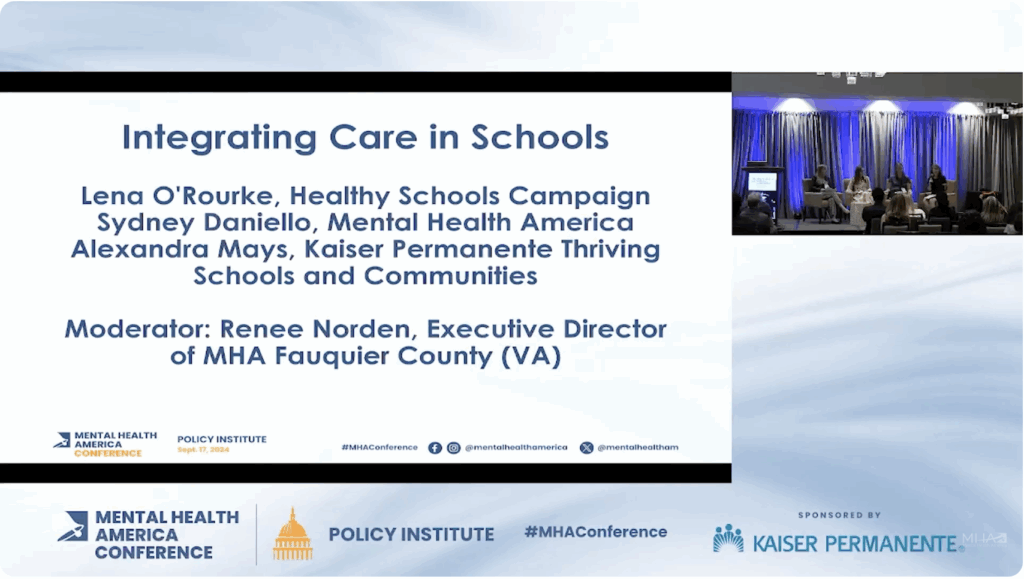
The intersection of education and mental health has never been more critical. Across the U.S., schools are facing a youth mental health crisis that directly impacts learning, attendance, and lifelong well-being. This panel discussion — moderated by Renee Snyder-Norden, Executive Director of the Mental Health Association of Fauquier County, Virginia — explored how schools can serve as pivotal access points for behavioral health services and how policy and funding can shape more equitable mental health systems for students.
Panel Overview and Speakers
The panel featured:
- Sydney Daniello, Public Policy Manager, Mental Health America
- Alex Mays, Program Lead, Kaiser Permanente Thriving Schools and Communities
- Lina O’Rourke, Founder, O’Rourke Health Policy Strategies and consultant for the Healthy Schools Campaign
Together, they discussed school-based mental health services, sustainable funding models like Medicaid, workforce challenges, and cross-sector collaborations necessary for long-term change.
The Bi-Directional Link Between Education and Mental Health
Education and mental health reinforce one another. Students facing untreated anxiety, depression, or trauma often experience chronic absenteeism, lower academic performance, and increased dropout rates. Conversely, lower educational attainment correlates with poorer mental health outcomes and even heightened suicide risk later in life.
The panel emphasized that supporting student mental health isn’t an extracurricular concern — it’s fundamental to academic success and community well-being.
Defining School Mental Health Services
As Sydney Daniello explained, “school mental health services” include the work done by school counselors, psychologists, and social workers who provide emotional, behavioral, and crisis support. These professionals play a vital role in:
- Identifying and addressing students’ psychological needs
- Supporting school climate and safety
- Connecting families to external care and resources
Such services extend beyond therapy — they shape how students feel, behave, and engage with learning.
Why School-Based Mental Health Services Matter
Alex Mays highlighted that schools are uniquely positioned to meet students’ mental health needs. With students spending over six hours daily on campus, schools provide accessible, stigma-reducing environments for care.
Research shows schools offering mental health support see:
- Lower chronic absenteeism
- Fewer behavioral incidents
- Better academic performance
- Greater equity in access to mental health care
For many children, particularly from low-income families, school is the only place they receive mental health support.
Challenges to Access and Equity
Despite progress, access remains uneven. Only about 1 in 5 children in need receive appropriate mental health care — and those numbers drop further for low-income and minority students.
Barriers include:
- Lack of providers, especially in rural areas
- Funding shortfalls and reliance on one-time grants
- Workforce shortages — an estimated 77,000 counselors and 63,000 psychologists short of national recommendations
- Fragmented systems that isolate education, healthcare, and community efforts
As Lina O’Rourke noted, “It often takes a donor to start a program — but sustainability is the real challenge.”
Medicaid and Sustainable Funding Models
One of the most transformative policy shifts came in 2014, when the Centers for Medicare and Medicaid Services (CMS) clarified that Medicaid could reimburse school-based services for all eligible students — not just those with Individualized Education Plans (IEPs).
This opened doors for schools to receive federal funding for services already being provided. However, implementation remains complex, requiring:
- State-level policy updates
- Provider qualification alignment
- Coordination between education and health departments
Recent federal initiatives, including the Bipartisan Safer Communities Act (2022), have encouraged states to expand Medicaid billing and invest in integrated care systems. Yet, as Alex and Lina emphasized, sustainable funding still demands cross-sector collaboration and advocacy.
Policy and Program Innovations Across States
Several states are pioneering innovative programs that blend policy, technology, and community partnerships:
Kansas: Mental Health Intervention Team Program
- Began in 9 districts; now expanded to 90+ schools
- Schools partner with community mental health centers
- Funded liaisons coordinate between schools and care providers
- Result: 33% improvement in attendance among students receiving care
North Carolina & Texas: Telehealth Models
- Rural districts use tele-mental health to address provider shortages
- Texas’ T-CHATT program connects schools with remote clinicians
- Attendance rates rose nearly 30% after program implementation
California: Youth Behavioral Health Initiative
- $4.5 billion statewide investment
- Enables both Medicaid and private health plans to pay for school-based behavioral health services
- Focuses on early intervention, prevention, and integrated care
Addressing Workforce Gaps and Training Needs
The shortage of school-based mental health professionals remains one of the largest barriers to progress. States are experimenting with pipeline programs that expose high school and college students to behavioral health careers and offer scholarships for graduate studies.
Examples include:
- Virginia’s pilot program for Youth Peer Support Specialists
- AmeriCorps-style initiatives placing recent graduates in rural schools
- “Grow Your Own” scholarship models to recruit local talent back into communities
Collaboration, Crisis Response, and Prevention
Collaboration between schools, health systems, and community partners is key. As Renee Snyder-Norden shared from experience in Virginia, local partnerships — even informal ones — can make all the difference. “We bring everyone to the table: schools, mental health providers, law enforcement, and youth programs. Once people realize we’re not competing for funds, the real change begins.”
A particularly emotional discussion highlighted the story of a young student who nearly lost his life to suicide due to gaps in care continuity. It underscored the urgent need for:
- Teacher training to recognize early warning signs
- Communication systems between schools and healthcare providers
- Family support mechanisms and awareness of resources like 988 (the Suicide and Crisis Lifeline)
Prevention remains underfunded but essential. As O’Rourke explained, “Federal Medicaid will pay for prevention services in schools, but defining and delivering them under policy rules is still tricky.”
Conclusion
The youth mental health crisis is both an educational and public health emergency — one that requires shared responsibility across systems. Schools are not just academic institutions; they’re front-line access points for care, equity, and early intervention.
The conversation around sustainable funding, workforce development, and integrated care must continue beyond conferences — in school boards, state legislatures, and local communities.
As the panel concluded: “Education is not just a path to success — it’s a social driver of mental health.”
Key Takeaways
- Education and mental health are interconnected. Students’ emotional well-being directly impacts their learning, attendance, and long-term success.
- Schools are vital access points for early mental health support — nearly 70–80% of children who receive care do so in school settings.
- Equity gaps persist. Low-income students and students of color remain disproportionately affected by limited access to quality mental health services.
- Medicaid reform opened new doors. The 2014 CMS policy change now allows reimbursement for school-based care beyond special education, but consistent state-level implementation is still needed.
- Innovative models are emerging. Kansas’s school–community partnerships, Texas’s telehealth programs, and California’s statewide behavioral health initiatives are leading scalable solutions.
- Workforce shortages hinder progress. The U.S. still needs tens of thousands more school counselors, psychologists, and social workers to meet demand.
- Prevention and crisis readiness are crucial. Training teachers, improving school–health communication, and promoting early intervention can save lives.
- Collaboration drives sustainability. True impact comes when education systems, healthcare providers, and policymakers work together to create coordinated, long-term mental health infrastructure.
Raw Transcript
[00:00] At this time I'd like to introduce the moderator for our first panel on education. Renee Snyder-Norden is executive director of our mental health association in Fauquier County in Virginia and she enjoys collaborating with community organizations and individual
[00:20] individuals to increase prevention, education, and treatment efforts to foster mental health in both Fauquier and Rappahide counties. Renee previously served as Highland High School's Director of Guidance for 15 years and worked as an emergency services clinician and suicide prevention specialist for encompassing
[00:40] community services. She's trained in mental health first aid and currently serves on several boards. She holds a BA in psychology from William and Mary and a master's in education and counseling from University of Virginia. Thank you, Renée. You can come this way.
[01:00] Freeze on a farm, I can do that. Thank you so much for being here. I'd like to invite our panelists up now so I can introduce them. What was funny is people were arriving. I was a little apprehensive because I was like, I've only seen my panelists in little boxes.
[01:20] trying to match them. And so I'd love to, let me first introduce them. So Sydney Daniello is the public policy manager of projects and events at Mental Health America and has been with Mental Health America since 2019 when she where she started as an intern. In her role she researches and writes policy
[01:40] projects and reports, particularly those focused on school-based mental health policy and strategy, youth leadership, social media and technology. Sydney also works closely with other members of the MHA policy team to plan MHA's policy events, including the Policy Institute. Sydney graduated from the George Washington University with a degree in psychology.
[02:00] with an emphasis on cognitive neuroscience. Civizone lived experience drives her passion for early intervention advocacy, school-based mental health initiatives, and mental health care for those living with chronic illnesses. Alex. Mays is the program lead for student behavioral health with Kaiser Permanente's thriving school.
[02:20] schools and communities team. Over the last 15 years, Alex has worked at the intersection of health and education on national, state and local efforts to change policies and systems to advance school and youth behavioral to advance school health. In her current role at Kaiser Permanente, Alex leaves the organization's work on children and youth behavioral.
[02:40] Health Initiative, including partnering with school districts across her state to expand access to school and mental health programs and services. Alice received her B.A. in Moroscience from Pomona College and her Masters of Health Science from Johns Hopkins Bloomberg School of Public Health. And Lina O'Rourke is the founder of O'Rourke Health Policy Strategies.
[03:00] as well as Healthy Schools Campaign's School Medicaid consultant. Lina is an experienced healthcare policy analyst and strategist focused on expanding access to high-quality, affordable health insurance and Medicaid. In a role as a consultant to the Healthy Schools Campaign, Lina provides strategic direction to the HSPF learning
[03:20] collaborative and direct support to state Medicaid and educational agencies and school districts. Lina is a dedicated advocate and strategist working to expand access to affordable high quality health care and other health justice issues that disproportionately affect the nation's most vulnerable populations. And with that,
[03:40] starter. Alright and so we have a couple of scripted questions but also please start thinking of questions because we have time at the
[04:00] end to have questions. So when we look at education as a social driver of mental health, it is crucial to understand the bi-directional relationship between education and mental health. Currently, as you all know, we have a youth mental health crisis. Our nation's students are facing
[04:20] this and it is the leading cause of chronic absenteeism in schools. Of course we know that higher absentee rates are associated with poorer academic achievement, an increase in the high school dropout rates, and lower educational attainment later in life. Then across the lifespan, long-term mental health inequalities,
[04:40] According to education level have been well documented. Leaving school at a younger age, fewer years in formal education, and having a lower level of education are each associated with poorer future mental health outcomes and even an increased risk of suicide. School mental health services are a unique and important part of efforts to address the
[05:00] youth mental health crisis as well as one of the foremost challenges currently faced by our education system. I think it's important to start off with some background. First off, what do we mean by mental health services in schools? Sydney? Thank you, Renee. So obviously there are a lot of different ways that we can address student mental health at school.
[05:20] from school climate to mental health education and more. But when we're talking about mental health services specifically, we generally mean the roles and responsibilities that a school mental health professional, like a counselor or a social worker, provide at school. And the most common services
[05:40] is
[06:00] of the school, whether that's in the community or somewhere else. Thank you, Sydney. Why are school mental health services so important? Who receives these services and what role do schools play in advancing mental health equality, our equity, in making sure that all children have access to care?
[06:20] Everybody. Again I'm Alex Meyiz. I'm with Kaiser Permanente's Thriving Schools and Communities team. I will just say to kick it off why Kaiser Permanente's Thriving Schools team really sees school mental health services as being critical is our whole team.
[06:40] team is oriented around meeting the unique health needs of schools and we see them as being a critical place to be meeting the health needs of students, of staff, of educators, and are very committed to working in partnership with schools and districts across the country to do this work. In terms of school mental health services,
[07:00] Building a little bit on what Sydney just said, it's really important to recognize this work that's been happening in schools isn't new, but for decades, schools have been delivering school mental health services. What's changed in the last four or five years has been with the COVID-19 pandemic,
[07:20] the youth mental health crisis, I think there's been a recognition as a society of the role that schools have been playing and can play in meeting youth mental health needs and the research really supports the impact and importance of school mental health services. When those services are in place, there are improvements in chronic
[07:40] absenteeism, we see reduction in behavioral challenges that may be faced by students, improvements in health care outcomes, and there's also a really strong case that the research makes for the role school mental health services can play in improving equity and access to mental health care. Students are at school.
[08:00] six hours a day, they don't need transportation to get the health care. They are there, they've built relationships with providers, and there's also data showing that they can help reduce stigma associated with mental health services as well as mental health issues overall. So I think overall
[08:20] can just play a critical role in supporting those outcomes overall. I will just add to that that school mental health services are so important because the obstacles that schools and students can face as a result of on them
[08:40] mental health needs can really impact their academic success, their social emotional development, and can raise concerns about school safety. And the access just really isn't there. So a lot of the majority of young people who need mental health services are
[09:00] not getting access to them. It's only about one in five children who should have access, need access to mental health services, actually get them and those numbers are even lower for low-income students and students of color who are at even higher risk for needing services and even less likely to actually
[09:20] actually receive appropriate care. And of the students who, of the young people who do receive mental health services, 70 to 80% of them are receiving them in schools. And that's, as Alex was mentioning, a really important place to access them because it does remove some of the barriers.
[09:40] transportation, socioeconomic status because parents are having to take time off of work to take their kids to external mental health care and like Alex said this the stigma as well is reduced when you're you're already there you're already in that place and you don't have to draw attention to going somewhere else to receive those services.
[10:00] So the one, and hi, can't speak me anywhere. I'm again, Lina O'Rourke with Healthy Schools Campaign. The one thing I just want to add on now,
[10:20] I think it belongs perfectly after Alex and Sidney's comments, but also sets me up a little bit for some of the financing conversation we'll have is the proportion of K-12 students who are covered by Medicaid or CHIP as their health insurance. And so one out of just about one out of every three
[10:40] kids in K-12 is covered by Medicaid as their insurance. That includes in some states children who are undocumented. In many states it does not. So there's still a lot of kids who are uninsured in this pool as well. When we talk about financing and ways to leverage it, I think it just builds.
[11:00] an important bridge to talk about the opportunities for these students to get care outside of school, which is often dictated by your source of health insurance as much as anything else. So we'll circle back to that. Thank you. So a recent study found nearly 50% of
[11:20] students reported anxiety, depression and stress make it difficult for them to do well in school. Student mental health is the leading driver of chronic absenteeism in school right now, a problem that has nearly doubled in prevalence since the start of the pandemic and does not show any signs of significant decline as of the last school year.
[11:40] What does research show about the effectiveness of providing school mental health services and reducing chronic absenteeism?
[12:00] is missing 10% or more of school for any reason. And schools that offer or are able to offer mental health services of any kind have shown improvements in attendance and overall well-being. Helping students to manage their stress, anxiety, depression,
[12:20] etc at school helps increase engagement and feelings of school connectedness which then drive improved attendance. When students feel supported psychologically and emotionally at school they're able to focus better on their studies and attend school more consistently.
[12:40] Also, providing these services in schools can help address some of the behavioral issues that end up contributing to chronic absenteeism through suspensions or expulsions. And not only do providing mental health services in schools help with immediate short-term issues, but the impact has been observed.
[13:00] undocumented longitudinally, meaning that students are showing improvements in their psychological and emotional resilience long term, and that supports them being able to attend school consistently and do well, which reduces their
[13:20] issue of chronic absenteeism over time. So some of the most effective service delivery models for providing school mental health services include school-based health centers, school and community partnerships, and school telehealth programs. And a recent study on
[13:40] school-based health centers, which are comprehensive healthcare centers that provide primary care, including mental health services, onsite at school. This study showed that there was increased attendance trajectories in the students who
[14:00] received care at a school-based health center for any reason, but the effects and positive impact that was observed on school attendance was magnified five times for students who received care specifically for mental health concern. Data from one of the first school and community partnerships
[14:20] programs showed that students who received care, 33% of students showed increases in attendance following receipt of care from that program and data from a new rural telehealth program that provided school mental health services showed that attendance rose by almost 30% of students.
[14:40] percent as a result of the establishment of that program and given that attendance rates often have an impact on the funding that schools and districts receive it's really important to highlight these investments that schools and districts have made to improve attendance because not only are they good for students academic success and achievement and their overall
[15:00] being, which of course is the first thing we care about, they also have the potential to drive a return on investment in those mental health services for the districts. So before I pass it off, I want to reiterate that education is a social driver of mental health, meaning that a person's
[15:20] level of academic success and the level of education that they're ultimately able to attain has an impact on their long-term future mental health outcomes and so it's really important to address anything that's getting in the way of students ability to do well and attend school.
[15:40] And the research has been really clear that providing school mental health services and getting those into schools is an effective way to address chronic absenteeism and its leading cause, which is unmet mental health needs from students. And so Sydney just shared what research has said.
[16:00] I can tell you anecdotally that individuals in it, there is no stoplight. There is no grocery store. There is no pharmacy.
[16:20] And one of our physicians retired and so now there is one physician for the company. So the school superintendent a number of years ago did a study on chronic absenteeism and her solution was a health-based clinic in the school. And so not only is it physical health,
[16:40] mental health services. They've also partnered with a local organization called Youth for Tomorrow that provides behavioral health services and so they have tele-mental health as well. And a nice donor actually gave Youth for Tomorrow a pot of money for those non-profit organizations.
[17:00] youth that could not afford services and they've seen a dramatic improvement. The other thing that is wonderful is now they are going to expand this health clinic not just for their students but for their teachers and plan in a number of years to then have also expanded to the older population.
[17:20] So there are some challenges. And I think we've named a lot of them so far.
[17:40] The stigma associated with accessing mental health services, the availability of providers in the community, health insurance. I'll let Alex speak a little bit more about the workforce piece, but I want to particularly call on.
[18:00] up the financing of mental health in general and specifically school mental health services. As a native Virginian, I know Rappahannock County and Renee's story really resonates with me and what is
[18:20] like a point to pull up. It took a donor to put the startup funds in. The sustainability of that program then becomes the upfront money. Local control makes a lot of the decisions about who is hired, but it's that sustainability
[18:40] ability piece, the scalability financing pieces that are challenges and we will talk about some of the solutions but I think that becomes one of the biggest issues. How do you get enough money to start a program? How do you get enough money to scale it?
[19:00] sure, despite having the health center and the school rene, not everyone is able to access all of the services that they need all the time. But what do we do to bring in that money and to braid it together to meet the need? Yes, and I would just double clicking a little bit also on what Lena said.
[19:20] sustainable funding and you know a huge challenge we see in the work that Kaiser's been doing with school districts across the country is that sustainable funding piece and so many as Lena said districts are breeding and blending multiple sources together and many of those are one-time grant-all
[19:40] that are ending. We're really running into this right now. You may have heard the term the fiscal cliff mentioned. COVID relief funds have played a key role in standing up school mental health services and programs across the country and those funds are ending this month and school
[20:00] districts are now faced with really challenging decisions around how to continue the good work that they have been able to implement with those dollars. We are working with a school district in San Diego County and found out that they're cutting half of their school counselors because they just don't have the funds anymore. And so, as we think about solutions to.
[20:20] mental health crisis and really expand school mental health services. That sustainable funding piece is key. Also, workforce shortages, not a surprise at all to anybody in this room, I'm sure, but very much what we're seeing playing out in terms of shortages across the entire mental health workforce is playing out in school districts as well.
[20:40] A lot of the districts we're working with, we hear that they have positions that have been posted for months and they aren't able to find the people to fill those positions. And the most recent data is that there would be 77,000 additional school counselors are needed to bring ratios.
[21:00] up to what the recommended number should be in school districts. It's 63,000 school psychologists, tons of thousands of school social workers. We know these shortages are unfortunately a reality in this work. And then just the last challenge I would mention, which is I think less concrete,
[21:20] really important to name that we see in this work is the silos that exist in meeting youth mental health needs I would say as this whole but really see them playing out with school mental health and we'll talk about it throughout the questions but I think Simon mentioned the importance of cross-sector collaboration to do this work and we
[21:40] very much see that as a need for school mental health services and figuring out how we can really break down silos that exist between health and education to ensure that students have access to care that's high quality, that's coordinated and that those systems that are serving youth are communicating.
[22:00] On the topic of sustainable funding, one of the most significant sources of federal funding for school mental health service is Medicaid. And as Lina shared, about 37% of American school-aged children receive health coverage through Medicaid and CHIP. In 2014, the
[22:20] Centers for Medicare and Medicaid Services issued a state Medicaid director letter that changed policy in a significant way and allowed states to use Medicaid more effectively to fund school health services. Can you all explain the change, why it was important, and how the school Medicaid program landscape has changed over the last 10 years as we move forward?
[22:40] result. So Medicaid has played a huge role in financing school medical services for decades and historically covered the services in a
[23:00] individualized education plan, IEP. But I always have to double check my numbers. About 2 million K-12 kids receive special education services out of the millions and millions of students who are in public education.
[23:20] So there are all these students out there receiving services, but for whom their school districts could not get Medicaid reimbursement. So again, this gets super nerdy policy very, very quickly, but historically only the students with an IEP could get Medicaid reimbursement.
[23:40] reimbursement. And in 2014, the federal government clarified that actually Medicaid acts like Medicaid in a school. If your student is on Medicaid and they get a service that is otherwise eligible for Medicaid reimbursement and it's provided by a qualified provider, you can get that
[24:00] service reimbursed in a school. So for that one out of three kids who are enrolled in Medicaid in K-12 education, all of the services that they receive, mental health or physical health services in a school, can be reimbursable under Medicaid.
[24:20] which is a lot of services and a lot of potential money. And that was the change in 2014 that really kicked off the conversation on school Medicaid. And how do you leverage that? And what do you do? And how do you build a state policy ecosystem that supports school distancing?
[24:40] districts and school providers in such a way that they can pull down all of that money. And it's tricky and it's hard and states have to take action. So a lot has happened to make that go a little bit better. But that core policy change.
[25:00] recognized to a large degree the role that schools and school health providers play in delivering services. And I want to clarify before I let both my colleagues talk or we go further in that this change reflects only one piece of
[25:20] of the school Medicaid puzzle. When I talk, I am exclusively referring to district-employed providers, so the people who the school hires, so the school counselors, the school psychologists, and the people hired by the district to be in the school to serve the students.
[25:40] But I really want to acknowledge the role of other health providers and particularly behavioral health providers who serve students in schools, whether that's through a school-based health center, whether that's through a community partnership. I mean, Sydney listed some of those programs, and they are such a critical
[26:00] collaborative part of the school environment, particularly where school district budgets are constrained, often community providers fill that role. In collaboration between the two, this is not a one or the other, this is all of these bodies are needed to serve these students. But I want to clarify that those
[26:20] community programs and the school-based health centers are financed differently because Medicaid is a lot and everything works a little differently and in every state. Those community providers are financed through their own funding streams, separate and distinct, not better, not easier, just
[26:40] different. So they're complementary and working that whole piece of this is really what the federal government is hoping for. But that policy change that Renee teed up, this free care policy change is those district employed providers.
[27:00] Okay. The expert is spoken. What policy efforts have been made more recently by the federal government to encourage the expansion of school Medicaid and states and what work is still left to be done at the federal level in order for schools to be able to make full use of this funding source? What kinds of policy
[27:20] have states taken to expand the school Medicaid? And that was teed up perfectly to let me do the next piece. So, in 2022, the Bipartisan and Safer Communities Act included very specific provisions, both regarding adolescent mental health and specifically school Medicaid.
[27:40] And it required CMS to put out new guidance, which they did in the summer of 2023. And they put out a whole new roadmap for how districts, and in particular state Medicaid agencies, can create a more robust and more
[28:00] are more integrated school-based Medicaid delivery system, so last summer. And as part of that, they really led with the first thing you need to do is make sure that your state policy says that the schools can
[28:20] reimburse for all Medicaid-enrolled students, leverage that free care policy. First get all the students reimbursable in a school setting. And then cover all of the services that they need in a school. Giving school districts a real ability to bill Medicaid for the services
[28:40] they are already delivering. What is happening in the school? What can they build for? And then they said, take a look at who the providers are. And this is something Alex and I have really spent a lot of time working on together. We all know that the landscape of behavioral health providers, particularly in the school, are not available.
[29:00] particularly in a school setting, there's a lot and they're all qualified and licensed to be providing services in the schools, but they're not always reimbursable under Medicaid. So tie that up, figure out through your state policy how to make sure that those behavioral health providers can bill for their services and by doing that,
[29:20] in even more money. And it is working and states have been able to bring in more federal money and are figuring out how to pass that back to the schools to reinvest. There are challenges, it's not super easy. I imagine Rappahannock County doesn't have a person whose whole job it is to sit there and bill Medicaid, which is not easy.
[29:40] It is not too simple, but it is extremely sustainable, and if you can leverage that and leverage those community partners can be real sustainable funding. So that's what we're seeing move forward. And a bunch of states got about a $2.5 million grant to figure this out a little bit more.
[30:00] So I think we'll see a lot of activity. This is the locus of a lot of federal and state activity. What else? Can I say one more thing? I get very excited.
[30:20] The challenge at this minute with School of Medicaid and the reason I think I'm so excited we have the opportunity to talk to you all at this minute is, again, I want to go back to what Alex said about the fiscal cliff.
[30:40] momentum from the safer communities act this momentum from CMS putting out this new school Medicaid guidance. The timing is ideal to use and to leverage school Medicaid. If not to backfill for the expiring grants to be very deliberate and
[31:00] very thoughtful about how you can in fact move the investments school districts have made in mental health from the ESSER side, from the school side, the education side, onto the Medicaid side. This is the exact
[31:20] moment to do that. And that does require partnership from the state education agency, from the state Medicaid agency, and from the school districts. To use Alex's example of San Diego, if a school district is cutting all of these positions, having a conversation across all of those departments
[31:40] can really think about how to do that, what needs to happen in a state, what needs to happen in a specific school district to reorient in order to pull down that money. So all of the hullabaloo around school Medicaid, which obviously I think is really exciting and great.
[32:00] is perfectly timed to happen at a time when school budgets will be dealing with this. So we want to leave that notion of the integrated care between systems so as you hear about opportunities, you are able to make that connection.
[32:20] action. And that's it. Thank you so much. And I think you know talking about that fiscal cliff, thinking outside the box, you know, we know there are challenges, we know there are funding challenges, we've already talked about workforce challenges. In the state of Virginia they are, they,
[32:40] state is looking at having youth peer support specialists. And so they have a couple of pilots going on to see how that would work. Another way of bringing more, you know, mental health trained focused people into school systems. A group of foundations in Virginia is exploring. They got a
[33:00] grant to create sort of an AmeriCorps system to place recent college graduates who are interested maybe in going into behavioral health but not ready to do the master's or anything like that, getting them into our more rural schools or into the schools that need it. And then also our local community servant
[33:20] community service boards are creating scholarship programs to grab our local kids early and giving like five thousand dollars for freshman and sophomore years, 10,000 for junior and senior year, and then 15,000 a year for grad school to bring them back to our communities.
[33:40] And so thinking about this, what policies and programs have done a good job at addressing the barriers and expanding access to mental health care in schools? What does the funding look like for these programs and are there opportunities to scale these programs up?
[34:00] before when I was talking about reducing chronic absenteeism, came from some really innovative policies and programs that were established to address some of the workforce barriers, workforce shortages and access barriers that schools and districts
[34:20] districts and states face. So there was a school and community partnership program that I mentioned that's called, the one I was referring to is called the Mental Health Intervention Team Program. It's in Kansas. And it started as a pilot program in nine Kansas school districts where the districts
[34:40] would receive money in order to enter into memorandums of understanding, which are just partnerships with community mental health centers that are local to the area, and then also to hire liaisons to work, to liaise between this.
[35:00] school districts and those mental health centers. And so the data that showed that 33% of students who received care through that program had improved attendance between that data and other positive outcomes that were documented.
[35:20] documented from that initial pilot program that led Kansas lawmakers to be able to scale up that program from the initial nine school districts to 90 school districts. It started in the 2019 school year with the nine districts and this past school year, the 2023-2020
[35:40] 24 school year, they had 90. And the other one of the other programs that I mentioned was a school telehealth program and that was the one I talked about before with the 30% increase in attendance as a result of that program that was in a rural area.
[36:00] Carolina. But there is another really innovative and exciting telehealth program in Texas called T-Shot that's operated by the Texas Child Mental Health Care Consortium to provide mental health services through telehealth at school.
[36:20] These telehealth programs are particularly effective in rural areas or areas where there just simply aren't enough qualified school behavioral health professionals to meet the needs of the district, but the benefits that we've talked about of providing services in schools can stay in touch.
[36:40] still be accessed if the district is able to tap into a workforce that exists somewhere else in the state and telehealth is a really good option to expand access and the benefits to the students. I want to chat a little bit more about funding, which is a topic that's near and
[37:00] So in addition, I will not try to recreate Lena's brilliance on explaining school Medicaid, but just do want to lift that up as an opportunity that states are pursuing to address the challenge of funding. I want to talk a little bit about what's happening in California on this front.
[37:20] just an example of programming that's being implemented to address some of the challenges we discussed. So Governor Newsom in California has rolled out an initiative called the Children and Youth Behavioral Health Initiative, which is a $4.5 billion investment in multiple programs.
[37:40] programs to address the children and youth mental health crisis in the state. One of the efforts that's happening through that is a change that requires health plans in the state, both Medicaid and private health insurance plans, to pay for
[38:00] for school behavioral health services that are delivered in school districts. So Lina was explaining the school Medicaid program through that program. Districts are for the most part directly billing their state Medicaid through their state Medicaid agency. The change California is implementing is in.
[38:20] parallel to that. They have their school Medicaid program, but they are allowing districts to begin billing health plans in the state. It is not without its challenges. I am happy to dig more into the complexity of that for anybody that wants to hear. But I do just want to share that I think overall, there has been.
[38:40] Work that's happening in states to shift accountability and Financing for school-based health services as a whole, but Certainly school mental health services more to the health Care sector. So highlighting that on the Funding front. And then i want to talk a little bit about some Solutions we've seen around
[39:00] workforce. I think in general a lot of the strategies that we see put in place to address the mental health workforce shortages as a whole can apply to addressing the school mental health provider workforce shortages, but in general some of the school-specific strategies that are being utilized across
[39:20] across the country are really focused on trying to get individuals who are interested in pursuing careers in mental health exposure to what school mental health is and what a career in that field might look like. So as an example, we're doing work with Sacramento County Office of Education. They have had a longstanding
[39:40] effort that is focused on building their entire career pipeline of getting more educators in, but then they have a specific focus around school mental health providers as well. And it starts there's a high school component where high schoolers who are interested in mental health can be going in and shadowing individuals in
[40:00] learning what careers in school mental health could look like. School sites are set up to receive interns for undergrad students who are pursuing degrees in mental health and wellness.
[40:20] To go to school sites to receive appropriate supervision to get hours towards their licensure. So there are examples like that. There's statewide initiatives that are similar to what's happening in Sacramento. But in general, I think that exposure and just introducing school mental health as a part of the program is important.
[40:40] possibility for individuals who are thinking about pursuing careers in mental health as a strategy that we've seen that has been used that has been effective. Okay, we have a couple more questions.
[41:00] Any questions? Yes. Very familiar with the moderator. There's a talk to them right now. Here, I can get from there. Okay. The moderator will leave the stage. Okay, so we run a program in Michigan.
[41:20] Michigan that's very similar to a lot of the things that you guys are talking about. It was featured at NatCon this year and so we have mental health therapists in our schools and one of the supervisors of those teams. We're looking at more of like prevention and so these barriers that you guys are talking about is like relationships, funding, and we get a
[41:40] lot of pushback right and so even in a community that's kind of in the rural north of Detroit had experienced a shooting they're very we wanted to put you know a health center there a lot of pushback and a lot of resistance from schools and so I really see what you guys are talking about
[42:00] with these partnerships between community mental health and schools, where are those relationships built and in what way are policies looking or funding, because I see this idea of Medicaid in schools, right? We bill their insurances, both private and Medicaid. Funding for prevention is that
[42:20] based on Medicaid? Is it something that we can do? So again, like we trained in youth mental health first aid, trained in assist, we want to offer those professional developments and those schools always just come back kind of with that. We don't have the money, we don't have the money, right? Yes.
[42:40] A couple of reactions in no particular order. First, Michigan is actually our gold star state for school Medicaid at a state policy level. Michigan, in
[43:00] response to a lot of the challenges that you just identified, including a series of school shootings, transformed the financing of their school Medicaid program. And it really is, at least on paper, one of the strongest programs. They wrapped in the behavioral health program.
[43:20] providers who are already in schools, they made sure all kids were billable, and they made a lot of structural policy changes, including and relevant here, crisis management services, because I think
[43:40] One of the many challenges with prevention in a school-based Medicaid system is that the services do have to be in a written plan of care, but a crisis won't have a written plan of care by its very nature of being an emergency in a crisis. So Michigan has a 30-day wait period that if, I don't know,
[44:00] I don't really know what else to call it, where if there's a crisis and after 30 days you have a plan of care in place, all of those crisis services will be covered. And different states do crisis services differently. Massachusetts is one of my favorite. They do, again, maybe not always in practice, but certainly on paper, they do a great job.
[44:20] covering crisis services. But crisis isn't the same thing as prevention, which is actually your question. And I will be totally honest that we have not cracked the nut on school-based Medicaid in prevention. The statute is extremely clear and CMS has reiterated time and time again that
[44:40] CMS, federal Medicaid will pay for prevention services delivered to a student in a school. I think there is no ambiguity on that. However, in practice that's really tricky because what do prevention services in schools really entail? Well a lot of the times it's classroom-based or school-based interventions.
[45:00] health school climates, teacher-led interventions. A teacher is not a Medicaid provider. We can't get that paid for because it has to be delivered by a qualified Medicaid provider. So who delivers the prevention services is a challenge.
[45:20] not insurmountable. It's just tricky. And this is what I think our community of school Medicaid folks is really looking at now and something that I think we will make great progress, but it's nascent in its thinking because I, you know, as a Medicaid
[45:40] finance person and not as a mental health person. I'm like well let's just get the counselor in there to do that and everyone tells me the million reasons that doesn't work, but I can pay for that. I know how to think about that. So to go back to the partnership pieces and how you build them from where I sit at the federal Medicaid level.
[46:00] I need the school district people, I need the school district Medicaid bill if they're participating, I need some of the providers to tell me what it actually looks like in service delivery, I need the youth to tell me what they actually want in order to meet their needs and what situations they would feel best on that. Then I also need the state
[46:20] Medicaid person to be at that table. So often, and I'm sure Alex has examples of this too, it just takes somebody really dedicated and some snacks and you build a table and provide some donuts and get that going and philanthropy can play a big role in that.
[46:40] you all could play a big role in that. A lot of the times that table is set by a community advocacy group, an affiliate of a group like MHA, like a CDF type group, the state school counselors association. Whoever that is, whoever has that 50 bucks for the donut.
[47:00] who can get everyone together and then keep it going. And I think we see that come from state agency occasionally, but honestly the role of the advocate and of the youth here I think is where I have seen the most new success in laying those tables
[47:20] sustaining them for real change. For our community, we have a mental health school collaborative. So as the MHA affiliate, we are the facilitator of this, but it brings in our school personnel, it brings in our local youth mental health
[47:40] Providers it brings in the sheriff's office the town police anyone who has a touchpoint with youth and that's where we bring programs like Youth mental health first aid Our youth mental health first aid is actually funded through another Asamseh grant that we didn't receive but they love our numbers so they will
[48:00] continue to pay the online portion and my staff does the teaching as part of our budget, things like that. So that I think is the easiest way to start having the people talk and realize that we aren't competing against each other for funds, but if we come together, we can fill all the holes.
[48:20] would just add, so I mentioned the work happening in California around school districts, billing health plans. A big goal of that initially was to figure out how to create new opportunities for reimbursing for preventative services. I think we're still waiting to see how that unfolds, but it's definitely an example worth looking at.
[48:40] One step they did take towards doing that is that a diagnosis isn't required to make the services reimbursable. And there are some codes that are included in the list of services that are eligible that are geared more towards the preventive space, psychoeducation, things like that.
[49:00] Another California specific example is through this children and youth behavioral health initiative. I mentioned one of the key programs We've been working on is called student behavioral health incentive program, but really at its core it's about breaking down the silos and building partnerships between the key entities
[49:20] that are serving kids in schools. And there's been a lot of lessons learned. I'm happy to chat more, but I think a big takeaway has just been the differences in language that are used, and then really looking again for opportunities for sustaining those partnerships. And so there's a lot of work.
[49:40] happening right now to execute memorandum of understanding between school districts and health plans and the Medicaid managed care plans in the state to continue that work. So I think there's some interesting levers that can be pulled to formalize that collaboration and those partnerships.
[50:00] say one sentence because it just builds off this and I do want to highlight it. Do bring the health plans and the Medicaid agency to the table. They're often the hardest to get and to keep, but really important. I'm so sorry. Thanks. I have been texting with my God sends mother.
[50:20] my godson's mother during this because she would be very interested and I just want you to know I have permission to tell my godson's story in public. He's given it to me. When he was in fifth grade he decided that he wanted to take his own life.
[50:40] And there was a lack of continuation of care from elementary school through middle school. And he lives in an underserved area. He is a young man with very dark skin. His mother is a woman with very dark skin.
[51:00] skin and there is a you know she said you know what are we doing to address these issues within schools that perhaps don't have the community group to buy the donuts and come together I mean that sounds nice but not every
[51:20] community has the opportunity to do that. How also are we preparing the teachers and the other people in the spaces to recognize when there is a problem? So this problem came to her plate when they called her and said, you know,
[51:40] But CJ said he's going to kill himself, this is how he's going to do it, you need to come and pick him up. Now thankfully she has the kind of job where she could leave her job and she could go pick him up. But how many people don't have that opportunity? When she picked him up they said
[52:00] He cannot come back to school until there's a letter and nothing else was given to her. She had access to information, but so many people don't. So I'd like to know your thoughts on that and how we kind of start to talk about filling those gaps.
[52:20] as well.
[52:40] thrown in. Currently they still have every new teacher take that and then research. But recently we found through the American Psychiatric Association Notice Talk Act which our Rappahannock school friends are bringing to their campus for all their buster
[53:00] drivers, dining hall workers, anyone who isn't in the other training. And the reason they are so open to this is because it is a much shorter amount of time. And so there are great programs out there. I encourage our families to continue to reach out.
[53:20] When they get those messages. That's why 988 is a fabulous thing for a family to be able to call and ask for information if they aren't getting it at their school systems. Thank you for sharing that. First of all. I want to just.
[53:40] zero in on what you said around the teacher component. I think that is making sure that there is training for teachers and appropriate professional development so that they feel supported and able to address the challenges that they are inevitably facing every day as well as knowing how to connect kids appropriately to care is huge.
[54:00] Another thing I'll just say that we're really thinking about as a health system with all the work that's happening in California is the role of health care in that and how do you coordinate care? We hear often on the other side that you have kids that are in the emergency room overnight for suicidal ideation and there's no way, unless the family decides to tell the school, that that has been.
[54:20] in the case for the school to know that. And so how can you improve those communication systems, have the data sharing in place, have coordinated care so that we are ultimately serving the child at the center and figuring out how best to align all those systems to meet their needs.
[54:40] Thank you so much for all your questions. I know we could probably talk all day about this subject. So please feel free to approach any of us later if you want to further our conversation. Karen? Thank you. Thank you. Thank you. Thank you.
[55:00] Thank you so much. Renee, Sydney, Lena and Alexandra, we know the case has been made and as you said, more can be discussed. But hopefully we can have some of these discussions back home in the States. As well as with our
[55:20] federal policy makers. It's a pleasure now to introduce the fireside chat moderator Donna Mosh from Massachusetts Association for Mental Health. She's the executive director, sorry, president and CEO and brings organizational leadership, operations management, evaluation,
[55:40] research and strategic consulting. Dr. Mausch's prior service in the private sector includes 10 years as a senior fellow, principal associate at Abbott Associates, chief administrative officer for comprehensive neuroscience, founding president and chief executive officer for Magellan Public Solutions, and
[56:00] founder and president of Integrated Health Strategies. She also presently serves as a court monitor for the U.S. District Court of Western Washington, addressing forensic services, reforms at the junction of health, disability, and justice. She holds a Ph.D. in social policy from Heller School at Brandy's University.
[56:20] Please welcome Donna and thank you so much for being here.